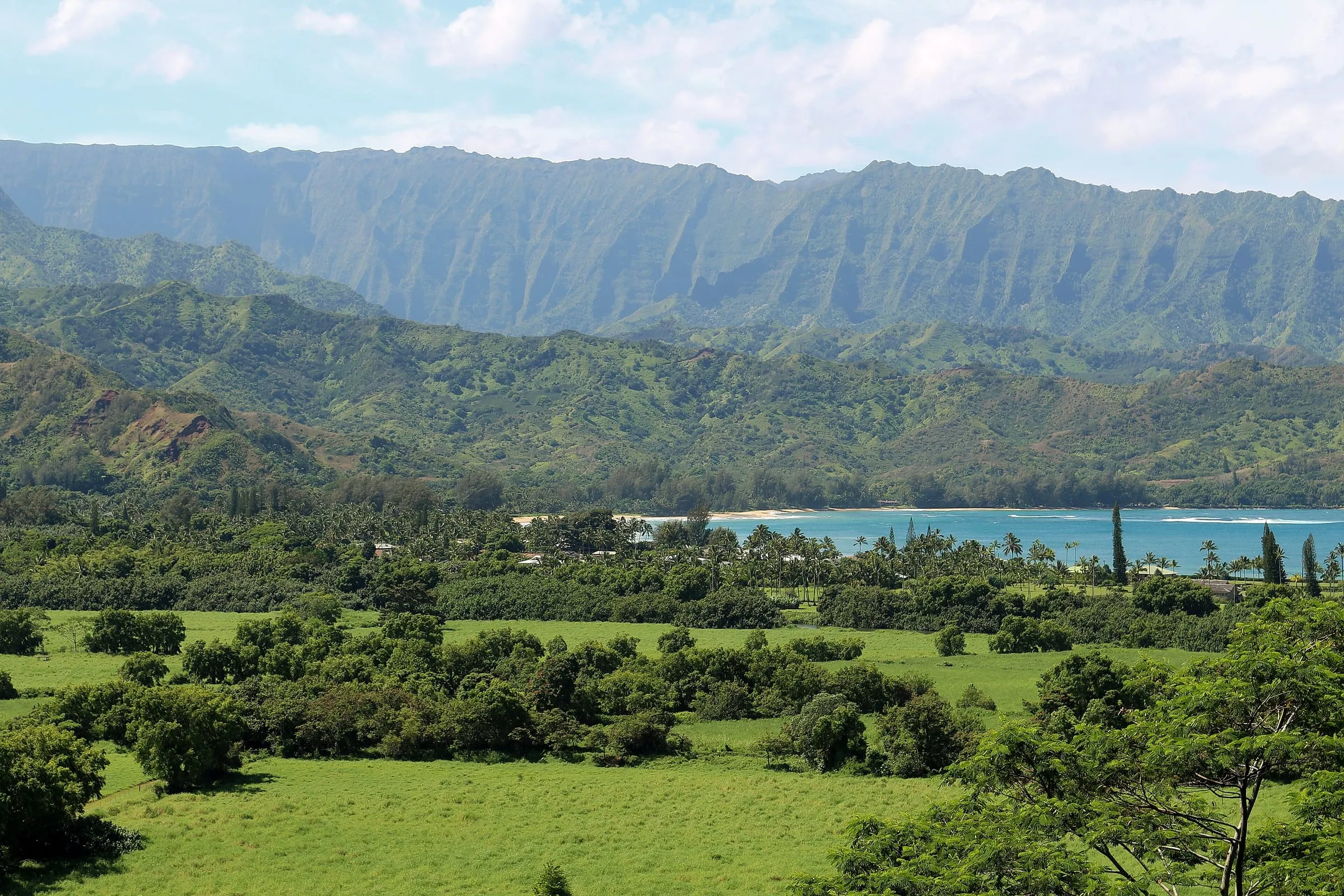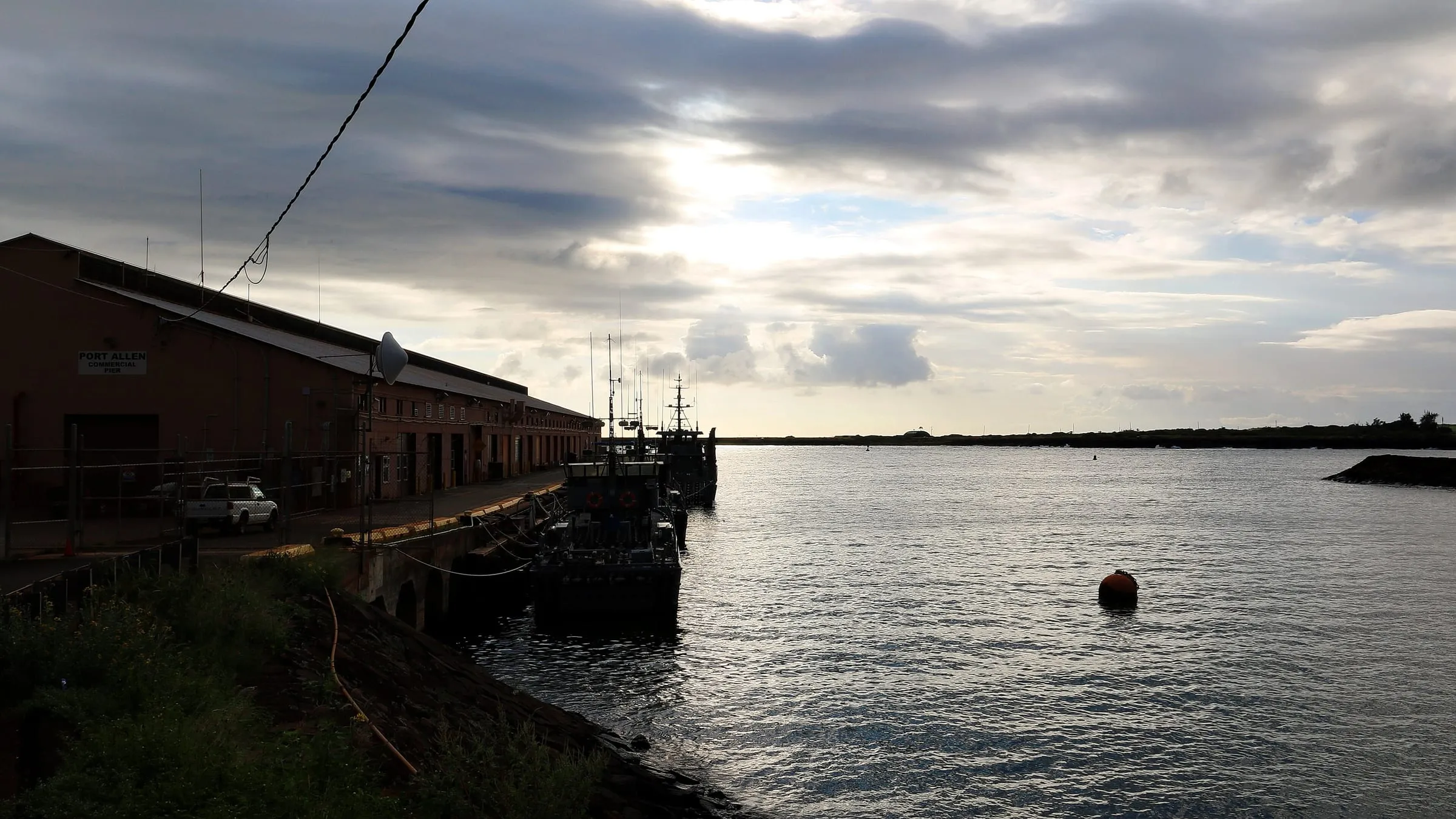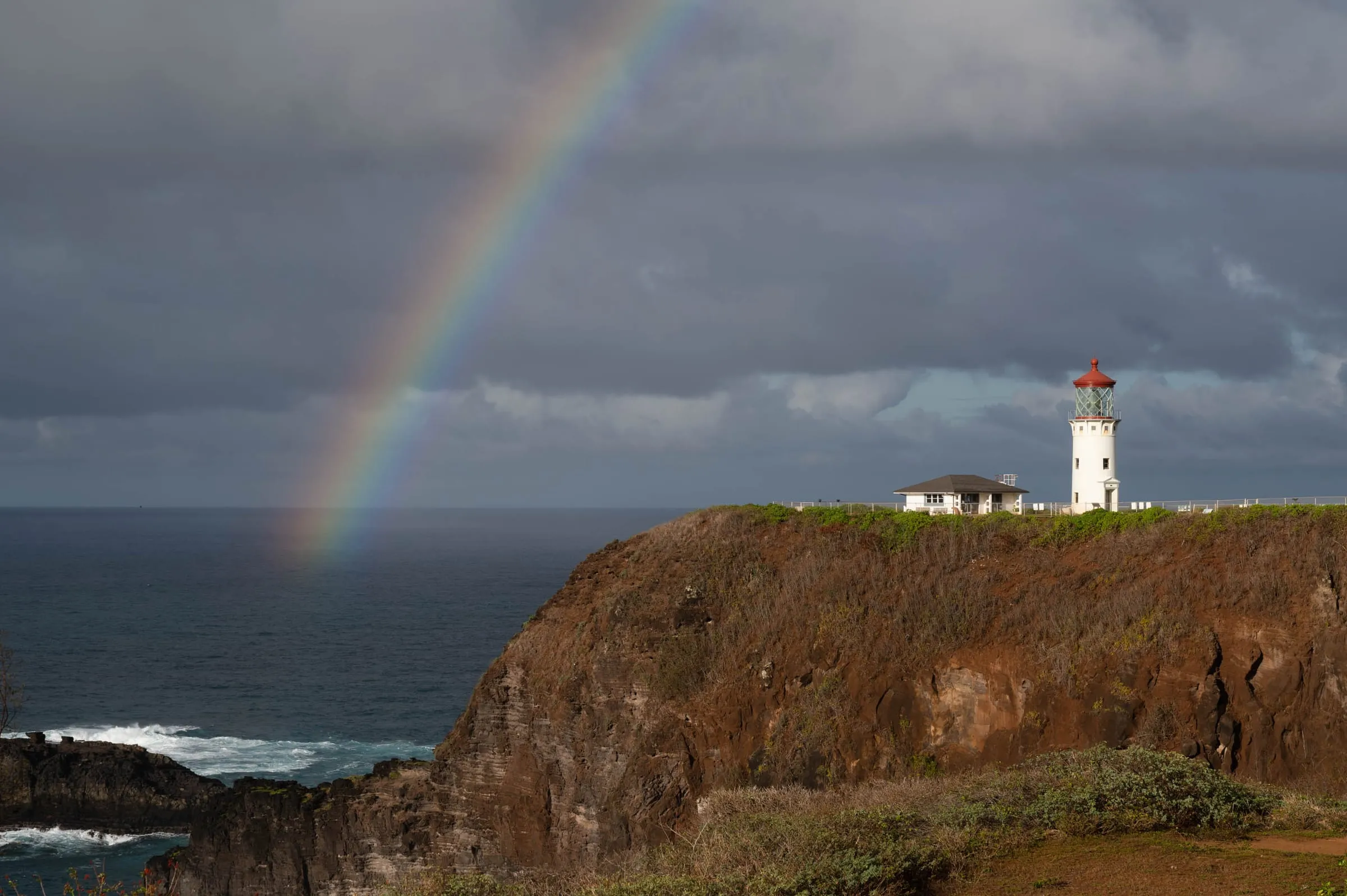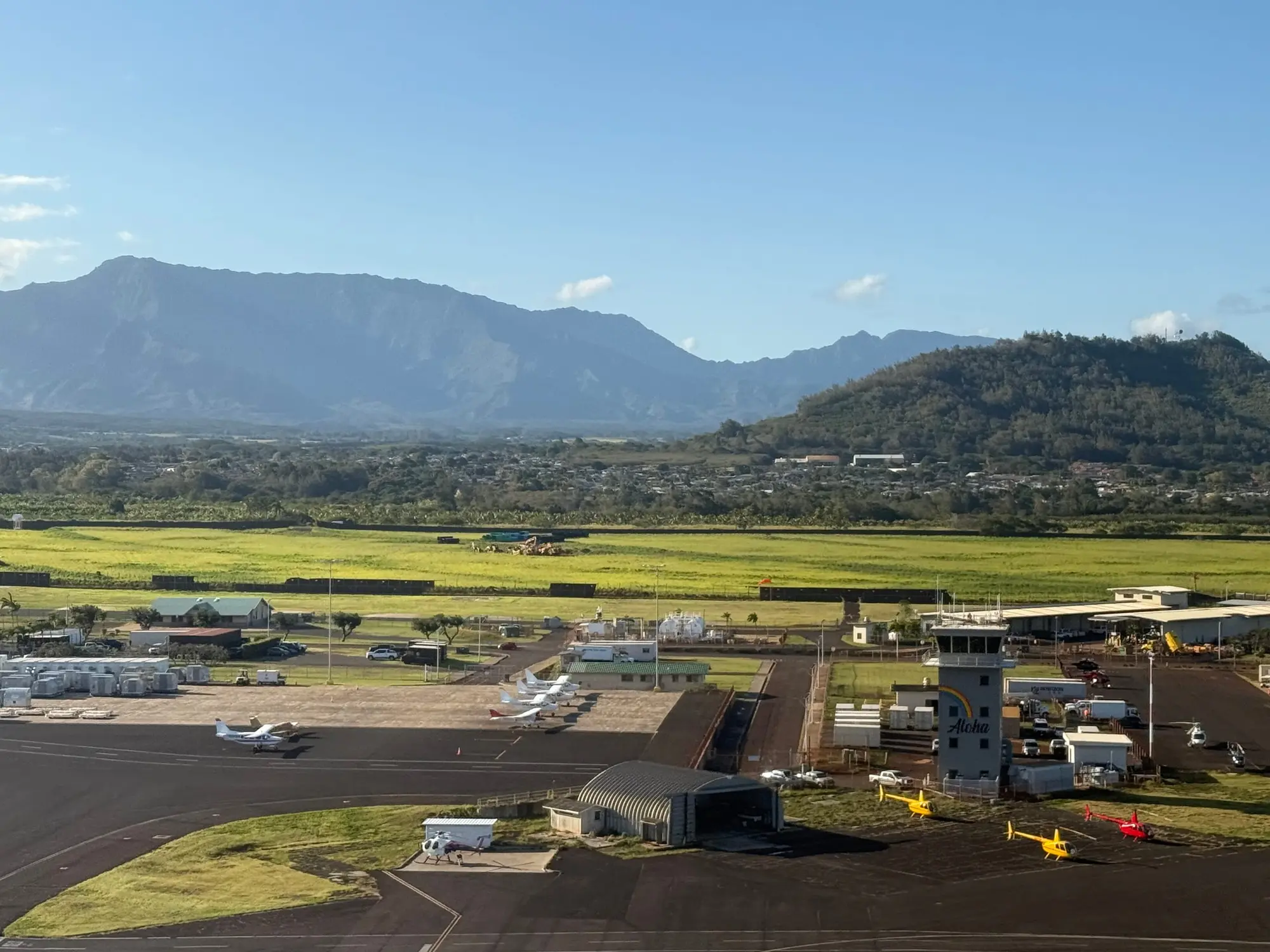
Every scheduled flight to Kauaʻi lands at Līhuʻe Airport (LIH), on the island’s southeast coast, about 1.5 miles east of Līhuʻe town. This winter eleven cities fly there nonstop, all of them in the western states: the West Coast from Seattle to San Diego, and inland Las Vegas, Phoenix and Denver. From anywhere else you change planes, on the mainland or in Honolulu, which is 49 minutes away. There is no passenger ferry from any island, and the only passenger ships that call are cruise ships, at Nāwiliwili.
What Hurricane Lowell left closed on the island in September, among the parks, harbors and roads, is on what is open on Kauaʻi.
Nonstop to Līhuʻe this winter
The Hawaiʻi Visitors & Convention Bureau publishes, month by month, every scheduled nonstop flight into the state, built from the airlines’ own schedules. Its grids for December, January and February, last updated on 16 October 2026, give Līhuʻe these, counted in flights to Kauaʻi in the month:
| From | Who flies it | December | January | February |
|---|---|---|---|---|
| Seattle | Alaska, Delta | 93 | 93 | 84 |
| Portland | Alaska | 15 | 31 | 28 |
| San Francisco | United, Alaska | 94 | 74 | 71 |
| Oakland | Southwest | 31 | 31 | 28 |
| San Jose | Alaska | 15 | 4 | none |
| Sacramento | Alaska | 24 | 20 | 16 |
| Los Angeles | United, Alaska, Delta, American | 137 | 98 | 80 |
| San Diego | Alaska | 31 | 31 | 28 |
| Las Vegas | Southwest | 31 | 31 | 28 |
| Phoenix | American | 46 | 36 | 28 |
| Denver | United | 33 | 32 | 31 |
| All eleven | 550 | 481 | 422 |
That is about 18 flights a day from the mainland in December, about 16 in January and 15 in February. A count of 31 in a 31-day month is a daily flight; 93 from Seattle is three a day.
What the table says about planning:
- Los Angeles has the most choice, four airlines, but it shrinks after the holidays. In December United flies 46 of its 137 flights, Alaska and Delta 31 each and American 29; United’s falls to 12 in January and 4 in February.
- San Jose is a holiday route: 15 flights in December, 4 in January and none in February.
- Every other city has at least a flight a day in all three months, except Sacramento, and Portland in December.
- From the mainland, Southwest flies only Oakland and Las Vegas to Līhuʻe this winter. Its route list also names Los Angeles and San Diego, but none of the three months has a Southwest flight on either.
The bureau calls every figure preliminary, “as carriers continue to modify them based on customer demand and aircraft availability”, and its grids for March and April are not out yet. Southwest’s own route pages put Oakland to Līhuʻe at 5 hours 35 minutes in the air and Las Vegas at 6 hours 30.
Alaska and Hawaiian share one code
Alaska Air Group bought Hawaiian Airlines in September 2024, and since 22 April 2026 both sell every flight under Alaska’s code, AS. A flight flown in Hawaiian’s colors, with its service, is shown as “operated by Alaska as Hawaiian Airlines”. The bureau’s grid therefore files every one of them under Alaska, and the table does the same: where it says Alaska, the plane may carry either name, and the airline’s booking shows which.
From the East, from Canada and from abroad
No flight reaches Līhuʻe nonstop from east of Denver. From the East Coast, the South or the Midwest you change planes: on the West Coast, in Phoenix or Denver, or in Honolulu, which in December has nonstops from Atlanta, Boston, Chicago, Dallas, Detroit, Houston, Minneapolis, New York JFK, Newark and Washington Dulles. Changing in Honolulu means a second, 49-minute flight; the next section has it.
From Canada, nothing flies to Līhuʻe this winter. WestJet canceled its seasonal Vancouver flights, which were to run four times a week from 7 December 2026, in its schedule change of July. The airport’s own list of airlines still names WestJet, but the bureau’s grid shows no flight from Canada to Līhuʻe in any month from November to February. WestJet flies from Vancouver and Calgary to Honolulu, Kahului and Kona and from Edmonton to Honolulu and Kahului; Air Canada flies from Vancouver to Honolulu and Kahului, and from December also from Vancouver to Kona and from Toronto to Honolulu. From any of them it is a short hop.
From Japan, Korea, Australia, New Zealand and the Pacific, every nonstop lands in Honolulu, where you clear U.S. immigration and customs before the flight to Līhuʻe.
The inter-island hop: Honolulu, Maui and the Big Island
| To Līhuʻe from | Nonstop on |
|---|---|
| Honolulu, Oʻahu | Hawaiian and Southwest |
| Kahului, Maui | Hawaiian and Southwest |
| Kona, Hawaiʻi Island | Hawaiian |
| Hilo, Hawaiʻi Island | No nonstop: change in Honolulu |
Honolulu to Līhuʻe is the busy one, 102 miles and about 49 minutes in the air. Southwest alone flies it five times a day on weekdays and Saturdays and four times on Sundays, and Hawaiian flies it too. From Kahului, 201 miles away, Southwest’s flight is once a day and about 59 minutes.
Kauaʻi works as a day from Oʻahu, by air. The flight is under an hour, and tour companies sell the day with the round-trip flights and a guided drive included, a 14- to 16-hour day. The island repays more than a day, though: the road does not go round it, and Waimea Canyon and the North Shore are at opposite ends of it.
The state’s agriculture declaration is only for flights from the continental U.S., so a flight from another island needs no form.
Why there is no ferry
No passenger boat runs between Kauaʻi and any other island. The last one was the Hawaiʻi Superferry, a high-speed catamaran, the Alakai, built for up to 866 passengers and 282 cars. It began sailing from Honolulu to Maui and Kauaʻi on 26 August 2007. Protesters on surfboards held it outside Nāwiliwili Harbor for about 90 minutes on its first voyage, turned it back on its second the next day, and it never sailed to Kauaʻi again. Five days in, the Hawaiʻi Supreme Court ruled that the state had erred in skipping an environmental review of the harbor work the ship needed. A special law let it sail again, and when service resumed that December it was to Maui; on 16 March 2009 the same court struck that law down, and the Superferry stopped three days later.
The state looked again. The Department of Transportation’s ferry study of December 2017 found that Nāwiliwili and Port Allen could take a ferry if a passenger shelter were built, but concluded that “in each area of analysis, the inter-island, intra-county, and intra-island ferry systems are infeasible”: too little pier space, too few likely riders and no route that pays for itself. The one passenger ferry between Hawaiian islands today crosses from Māʻalaea on Maui to Mānele on Lānaʻi, and Maui County’s plans for a public service reach Lānaʻi and Molokaʻi, not Kauaʻi.
So every way to Kauaʻi is a flight, unless you arrive on a cruise ship.
By cruise ship, at Nāwiliwili
Cruise ships dock at Nāwiliwili Harbor, in Līhuʻe, 2.7 miles from the airport. Pride of America calls every Thursday and stays until Friday afternoon; every other ship on the port’s calendar to 31 March stays one day. Kauaʻi on a cruise stop has the port’s hours, what fits a one-day call and what fits the overnight.
Landing at Līhuʻe Airport
Every airline flight uses the Kawakami Terminal, with check-in and baggage claim both on the ground level.
Coming from the mainland, have the agriculture form done. The Hawaiʻi Department of Agriculture & Biosecurity requires its declaration on every flight from the continental U.S., by state law, and one adult can complete it for the family. It is handed out on the plane, and on the flights that offer it, it can be done online through Akamai Arrival. Plant quarantine inspectors work in the baggage claim area, and anything agricultural you declare is examined there.
Most rental cars are across the street. From baggage claim, walk across to the rental-car booths; the eight companies there hand over and take back their cars behind them, and a few others, Sixt and NU Car Rental among them, run a shuttle to an off-site lot. Getting around Kauaʻi has the car, whether you need one, and the county’s Kauaʻi Bus, which stops in the median in front of the terminal.
Taxis wait at the curb outside baggage claim. The airport posts a guide to the fares, which it does not guarantee:
| Area | Taxi from the airport, its guide |
|---|---|
| Līhuʻe to Kukui Grove | $9.00 to $12.75 |
| Wailua to Waipouli | $22.00 to $27.60 |
| Poʻipū | $42.00 to $52.50 |
| Princeville to Hāʻena | $88.50 to $118.50 |
How far everything is. From the terminal, on OpenStreetMap’s routing at the posted limits with no traffic, so treat each as the least it takes:
| From Līhuʻe Airport to | Distance | Time |
|---|---|---|
| Kapaʻa Beach Park | 7.8 mi | 17 min |
| Kōloa town | 12.3 mi | 26 min |
| Poʻipū Beach Park | 15.3 mi | 34 min |
| Princeville | 28.8 mi | 53 min |
From the rental-car lots across the street each drive is up to two minutes shorter; getting around Kauaʻi has the drives from there to every side of the island. Which side of the island to sleep on is where to stay on Kauaʻi.
The curb is a work zone until about March 2027. The state’s work on the terminal’s three crosswalks and traffic signals, set to start on 26 May 2026 in six phases, is estimated to finish in March 2027; it closes one crosswalk at a time and takes lanes from the curb. The curb is for loading only; anyone collecting you either waits in the cell phone lot until you are outside with your bags, or parks in the public lot and meets you at baggage claim.
Flying home: the agriculture inspection
Everyone flying from Līhuʻe to the mainland goes through a USDA inspection first. Its stations for checked bags stand in front of or at the airline counters, so your bags are inspected before you check them, and everything you carry on is inspected at security. You must present all food, plants and other agricultural items to the inspector. The rule keeps fruit flies and Hawaiʻi’s other pests off the mainland, where a single piece of fruit carrying one could cost its farms millions.
| Allowed to the mainland, after inspection | Not allowed |
|---|---|
| Fresh pineapple and coconut | Most other fresh fruit and vegetables |
| Roasted or green coffee beans, any amount | Berries of any kind, fresh coffee berries and sea grapes included |
| Cooked, dried and commercially canned foods, and frozen ones if frozen solid (frozen mango without its seed) | Kikania, fresh pandanus and swamp cabbage |
| Irish or white potatoes | Fresh flowers of jade vine and Mauna Loa, and cotton and cotton bolls |
| Papaya, abiu, atemoya, banana, curry leaf, dragon fruit, longan, lychee, mangosteen, rambutan, starfruit and sweet potato, only if treated at a USDA-approved facility and packed in sealed boxes that are marked and stamped | Mock orange, cactus and sugarcane |
| Fresh flowers, leis and foliage, other than those above and anything in the citrus family | Any plant in soil, and soil |
| Shells (not land snail shells), seed leis and seed jewelry, dried seeds and driftwood | Seeds with fruit clinging, fresh seed pods, and live insects and snails |
A lei with mock orange or any citrus in it stays in Hawaiʻi. Some states also want a rooted plant certified by Hawaiʻi’s Department of Agriculture & Biosecurity before it travels.
A trip that ends on another island skips the inspection. The TSA checkpoint is open from 5 a.m. to 11 p.m. every day.