
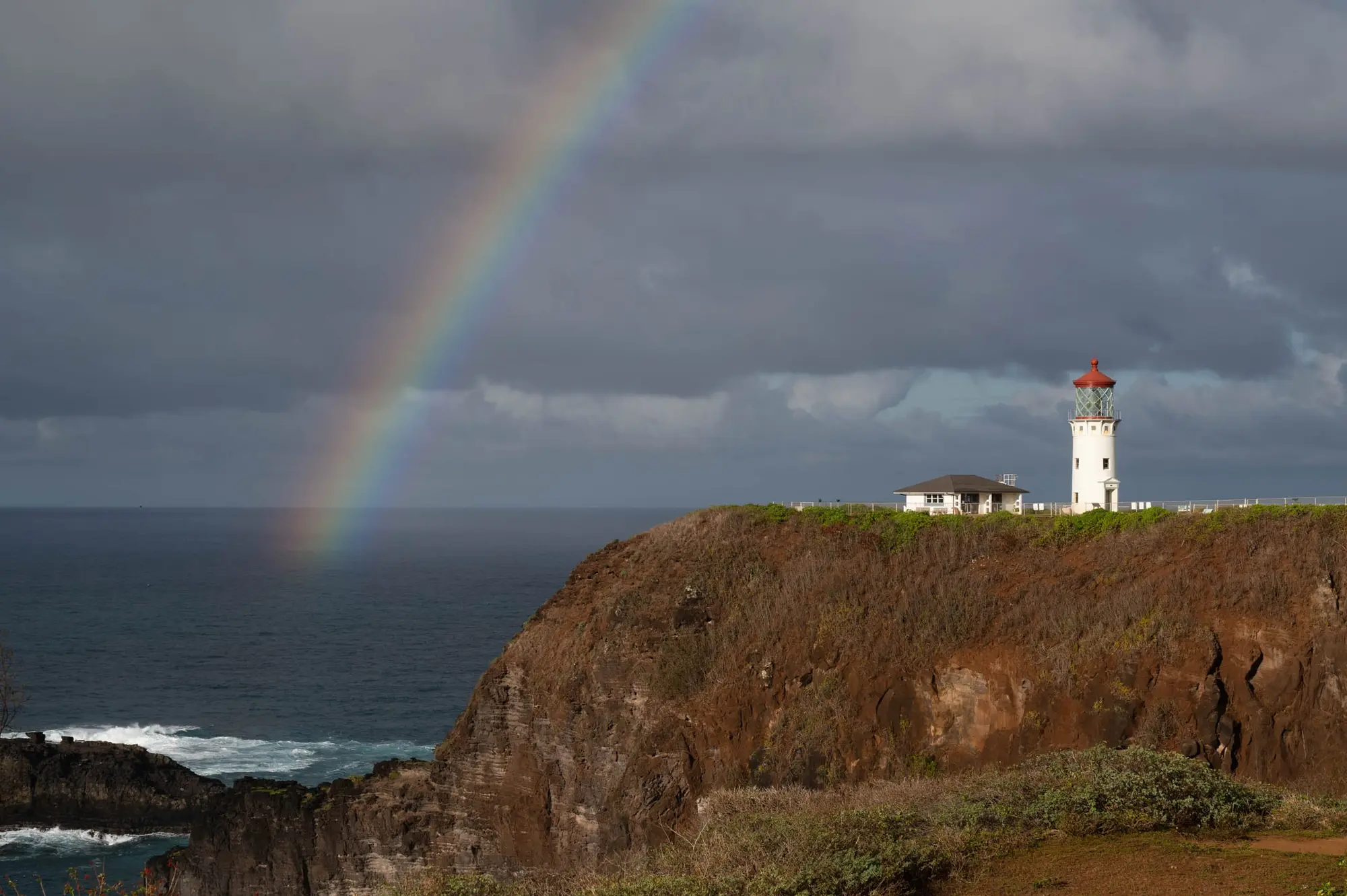

December to March is the heart of whale season on Kauaʻi, and the North Shore’s rough, wet season. Humpbacks are here from November to April or May, by the federal whale sanctuary, and the shared whale boats sail from Port Allen from mid-December to the end of March. The same months bring the big winter swells onto the North Shore, and two of its three wettest months, so the swimming days belong to the drier south shore, and the North Shore days to looking: at the surf, at Keʻe and the Nā Pali cliffs, and at the whales from the Kīlauea Point headland. Below are the dates that matter from December 2026 to March 2027, each month in turn, and the order to book in.
The dates that matter
| Holiday | Date | Hāʻena reservations for it open |
|---|---|---|
| Christmas Day | Fri 25 Dec 2026 | Wed 25 Nov, 12 a.m. Hawaiʻi time |
| New Year’s Day | Fri 1 Jan 2027 | Wed 2 Dec |
| Martin Luther King Jr. Day | Mon 18 Jan | Sat 19 Dec |
| Presidents’ Day | Mon 15 Feb | Sat 16 Jan |
| Prince Kūhiō Day and Good Friday | Fri 26 Mar | Wed 24 Feb |
Every one is a Hawaiʻi state holiday, by the state’s own list for 2026 and 2027, and in 2027 Prince Kūhiō Day, the state’s holiday for Prince Jonah Kūhiō Kalanianaʻole on 26 March, falls on Good Friday, two days before Easter Sunday, 28 March. Each holiday makes a three-day weekend.
Hāʻena State Park sells each day 30 days ahead. Go Hāʻena, the park’s reservation site, opens a date at 12 a.m. Hawaiʻi time, 30 days before it (its own example: 30 August opens on 31 July), and its parking reservations “usually sell out by 12:01a.” Everyone without a Hawaiʻi ID needs a reservation, on a holiday as on any other day, to enter the park, reach Keʻe Beach or walk the Kalalau Trail to Hanakāpīʻai. The park is open every day, holidays included, 7 a.m. to 6:45 p.m., and on the winter schedule the last shuttle leaves the park at 5:40 p.m. The shuttle, the parking and their prices are on the Hāʻena reservations page.
| Other dates | What happens |
|---|---|
| Fri 4 Dec | The Lights on Rice Christmas parade, on Rice Street in Līhuʻe, 6:30 p.m. The street closes from 5:30 |
| Mid-December | The shared whale boats from Port Allen start: the first dates on sale were 16 and 18 December |
| Sat 30 Jan, Sat 27 Feb, Sat 27 Mar | The Sanctuary Ocean Count: volunteers count humpbacks from the shore on Kauaʻi, Oʻahu and Hawaiʻi Island, in the morning |
| Sun 14 Mar | Mainland clocks go forward. Hawaiʻi’s do not |
| Wed 31 Mar | The last date on sale for the whale raft we link |
Month by month
| December | January | February | March | |
|---|---|---|---|---|
| Rain, Līhuʻe Airport | 4.6 in | 2.8 in | 3.6 in | 5.6 in |
| Rain, Princeville Ranch (North Shore) | 8.0 in | 5.4 in | 6.6 in | 8.3 in |
| Rain, Makaweli (west side) | 4.2 in | 2.1 in | 2.4 in | 3.9 in |
| Average high and low, Līhuʻe Airport | 79°F / 69°F | 79°F / 66°F | 78°F / 66°F | 79°F / 67°F |
| Sunset at Hāʻena | 5:54 p.m. on the 1st, 6:06 on the 31st | 6:16 p.m. on the 15th | 6:35 p.m. on the 15th | 6:48 p.m. on the 15th |
The rain and temperatures are NOAA’s 1991–2020 normals; the sun times are the US Naval Observatory’s, in Hawaiʻi time. January is the driest of the four months at all three gauges, and March the wettest at Līhuʻe and Princeville. The North Shore gauge takes about half as much again as Līhuʻe in March and close to twice as much in January: about 28 inches over the four months, against 17 at Līhuʻe Airport and 13 at Makaweli.
This winter may run drier than those numbers. On 22 October 2026 the National Weather Service’s Honolulu office said El Niño had reached the very strong category and that the climate models favor “unusually high probabilities for below normal rainfall statewide through early spring 2027.” In strong El Niño winters, it added, the chances of below-normal rain have been highest in the second half of the winter and into spring. Such winters tend to bring weaker trade winds, it expects warmer than normal temperatures into early winter, and if the forecast holds, drought in many areas later in the winter. A dry forecast does not rule out the storm that matters on Kauaʻi. In the same advisory: “Flash flooding can still happen within a drought.”
December opens the shared whale boats’ season and the holidays. The first shared whale-watch dates on sale from Port Allen were 16 and 18 December when we read the calendars on 10 November 2026. The Lights on Rice parade, the Rotary Club of Kauaʻi’s Christmas parade, comes down Rice Street in Līhuʻe on Friday 4 December at 6:30 p.m. Christmas Day is a Friday: Hāʻena State Park is open, as on every holiday, and the Kīlauea Point refuge is closed. These are the year’s shortest days.
January is the driest month of the four, with the coolest nights, a 66°F average low at Līhuʻe Airport, and the darkest mornings: at Hāʻena the sun rises after 7:15 all month. Kauai Sea Tours checks in its Lucky Lady Nā Pali cruise at 6:45 a.m., which in January is before first light, so the drive to Port Allen is in the dark. Martin Luther King Jr. Day is Monday 18 January, and the sanctuary’s first shore count of 2027 is Saturday 30 January.
February is the middle of the whale season and the coolest month by day, a 78°F average high at Līhuʻe Airport. Presidents’ Day makes a long weekend of 13 to 15 February, and the second count is Saturday 27 February.
March is the wettest of the four at Līhuʻe and Princeville on the normals, though in strong El Niño winters the odds of below-normal rain have been highest late in the winter and into spring. Mainland clocks go forward on Sunday 14 March and Hawaiʻi’s do not, so from then Kauaʻi is six hours behind New York instead of five, and three behind Los Angeles instead of two. Friday 26 March is both Prince Kūhiō Day and Good Friday, the last shore count is Saturday 27 March, and the whale raft we link has dates to 31 March.
Whale season
Humpbacks come to Hawaiʻi each winter to mate, give birth and raise their young. The Hawaiian Islands Humpback Whale National Marine Sanctuary puts the season at November through April on its home page, when they can be seen “from shore and at sea,” and through May in its boating guidelines, and the Kīlauea Point refuge on the North Shore starts it in October. The sanctuary counts during the peak, from the shore on the last Saturday of January, February and March: in 2027, 30 January, 27 February and 27 March. Visitors can join a count site on Kauaʻi through oceancount.org.
Every boat, paddler and swimmer must keep 100 yards from a humpback, so how close you come is the whale’s choice.
From the shore, the Kīlauea Point National Wildlife Refuge, at the end of Kīlauea Road, is the North Shore’s best seat. It opens Wednesday to Saturday, by reservation, and it closes on major holidays, or on the Saturday before one that falls on a day it is shut. In 2026 it closed on a Saturday for Presidents’ Day, so check its events page before counting on Saturday 13 February 2027, the only open day of that long weekend. Christmas Day is on its list of closures, and New Year’s Day, also a Friday, falls under the same rule.
From a boat, the two shared whale trips on this page leave Port Allen:
- Captain J’s whale watch, our pick for whales: two hours on an open super raft, on sale every day from 16 December to 31 March when we read its calendar on 10 November 2026.
- Kauai Sea Tours’ whale-watch cocktail cruise, on ʻImiloa, its express catamaran with a bar and two restrooms: on sale only from 18 to 31 December that day, its January to March dates not yet out.
A boat of your own, Ocean Charters Kauai’s private charter from Port Allen, is on sale from 15 November to 15 April. Whale watching on Kauaʻi sets the four whale boats we link side by side, with each one’s departures, prices, ages and health rules, and the headlands to watch from. Holo Holo’s Nā Pali sunset dinner cruise watches for humpbacks from December to April too: it is on the Nā Pali boat tours page.
From the air, Wings Over Kauai’s 65-minute Kauai Deluxe Sightseeing Flight takes in Kīpū Kai and the whole Poʻipū shoreline, which its listing says the helicopters have no time for, and watches for whales along it, as well as the Nā Pali, Waimea Canyon and the Hanalei Valley. It is $159 a person from Līhuʻe Airport. The helicopters are on Kauaʻi helicopter tours.
The North Shore in winter
Winter’s big swells come out of the north and northwest and land on the North Shore. The Weather Service’s Honolulu office issues a high surf advisory for north-facing shores at 15 feet and a warning at 25, and Go Hāʻena tells visitors to “Expect rough ocean October to April” at Keʻe, where “lifeguards may close the beach if unsafe.” Inside Hāʻena State Park, Keʻe is the one place it says to go into the ocean at all, and it warns of waves at Hanakāpīʻai that hit bystanders on the shore. Hanalei Bay, calm in summer, is a surf break in winter, and the reef at Tunnels is no place to be in a big swell. Kauaʻi ocean safety has which beaches are guarded and what the warnings mean.
It is the rainy side too: about 28 inches at the Princeville Ranch gauge from December to March. Go Hāʻena calls the streams on the trail to Hanakāpīʻai “high risk for unexpected, FLASH FLOODING”: do not cross one that is rushing or murky, and if the water rises, stay on your side until it falls. Kalalau Trail permits covers the trail itself. The one-lane Hanalei Bridge, the only road in to Hanalei, Wainiha and Hāʻena, closes when the river floods.
None of this makes the North Shore a bad idea in winter. It makes it the side for looking: Keʻe Beach and the first two miles of the Kalalau Trail with a Hāʻena reservation, the surf at Hanalei, and the whales from Kīlauea Point. In winter the Nā Pali boats run from the west side; the few that still go out from Hanalei run short sightseeing trips.
The south and west shores: the drier side
Poʻipū faces south, away from the winter swells, and Makaweli, on the west side, is the driest of the three gauges above in every one of these months: 2.1 inches of rain in January. That makes the south shore the place for a winter swim or snorkel. Poʻipū Beach has its own page.
A snorkel from the beach. Z Tourz’s guided shore snorkel goes in from a beach on the Poʻipū coast, no boat, with a certified dive instructor and eight guests at most: two hours with a safety briefing and a lesson, up to an hour on the reef, gear and flotation included, and tropical fish, sea urchins and sometimes a green sea turtle or a monk seal. You check in at Z Tourz’s office on Poʻipū Road in Kōloa town, and the guides pick the beach for the day’s sea. It is $119.80 a person, the same for adults and children, with dates nearly every day of the winter. After you book, Z Tourz texts you to finish the reservation and emails the directions. No one over 300 lb can go, and you need to be comfortable in the water. Snorkeling tours on Kauaʻi has the rest.
The Nā Pali by boat leaves from Port Allen on the west side all winter. The coast faces north and west, into the swells, so a rough day changes the trip: the snorkel stop goes, the sea caves are out of reach, and Kauai Sea Tours’ Lucky Lady may reroute to the south coast instead, which it does not refund. Go in the morning, and early in your stay, so a lost day can be moved. For the Nā Pali in winter, our pick is the Lucky Lady all the same: a big catamaran is the steadiest kind of boat on that coast, it sails nearly every morning of the winter, and it stops to snorkel when the sea allows. Our Nā Pali page picks it for most people too. Nā Pali Coast boat tours compares the catamarans, the raft and the sunset cruise.
Waimea Canyon and Kōkeʻe reopened on Saturday 7 November 2026: Waimea Canyon and Kōkeʻe has the lookouts and the drive, and what is open on Kauaʻi has what is still shut.
After Hurricane Lowell
Hurricane Lowell passed just west of Niʻihau on the night of 7 September 2026, and its surf damaged the small boat harbors on the west and south shores. The state has reopened Kauaʻi’s parks in stages since 21 September, Hāʻena on 15 October and Waimea Canyon and Kōkeʻe on 7 November, and the Port Allen boats on this page had their winter dates on sale on 10 November. A few places were still closed that day, and the state’s own notices contradict themselves on forest-reserve camping and on the Wailua River. What is open on Kauaʻi has each place, its status and the notice behind it, dated, and is the page to check before you go.
Where to sleep in winter
The side of the island decides the trip more than the bed does. For the beach days and the Port Allen boats, the south shore: Booking.com files Poʻipū’s resorts under Kōloa. For the middle of the island, an easy drive to the airport and the Wailua River, the east side, Kapaʻa and Wailua. Princeville is the North Shore base, and the wettest of the three in these months; the two resorts we name there, and the county’s rule on which houses may rent to visitors, are on where to stay on Kauaʻi.
Book in this order
- The side, then the bed. For a winter trip built around the water, the south shore; for the middle, the east side.
- Hāʻena, the night your date opens, 30 days ahead at 12 a.m. Hawaiʻi time, if Keʻe or the Kalalau Trail is on the list.
- The whale boat, the Nā Pali boat or the flight, early in your stay, so a day lost to the weather can be moved. Every shared trip on this page is free to cancel until 24 hours before; Ocean Charters Kauai’s private charter needs 14 days’ notice.
- A car. The trips on this page start from Port Allen, Kōloa and Līhuʻe, and the North Shore is the other end of the road: getting around Kauaʻi has the rental and the bus, and tours by where you stay has the drive from each side of the island to each harbor.
How these months compare with the rest of the year is on the best time to visit Kauaʻi.


