Poʻipū Beach Park is where Kauaʻi goes to swim. It is about 1,100 feet of sand on the south shore, with two county lifeguard towers, a wading pool behind a boulder breakwater, a sandbar out to a rocky point and a lawn with pavilions behind it. The island’s lifeguards call it the busiest beach on Kauaʻi, for visitors and residents alike, all year round. Their association glosses the name as “crashing waves.”
It is also one of the beaches where Hawaiian monk seals come ashore to sleep, and the rules for that are short and worth knowing before you arrive.
The beach, end to end
The beach park backs the eastern half of the sand, and hotels back the western half. Three places on it matter:
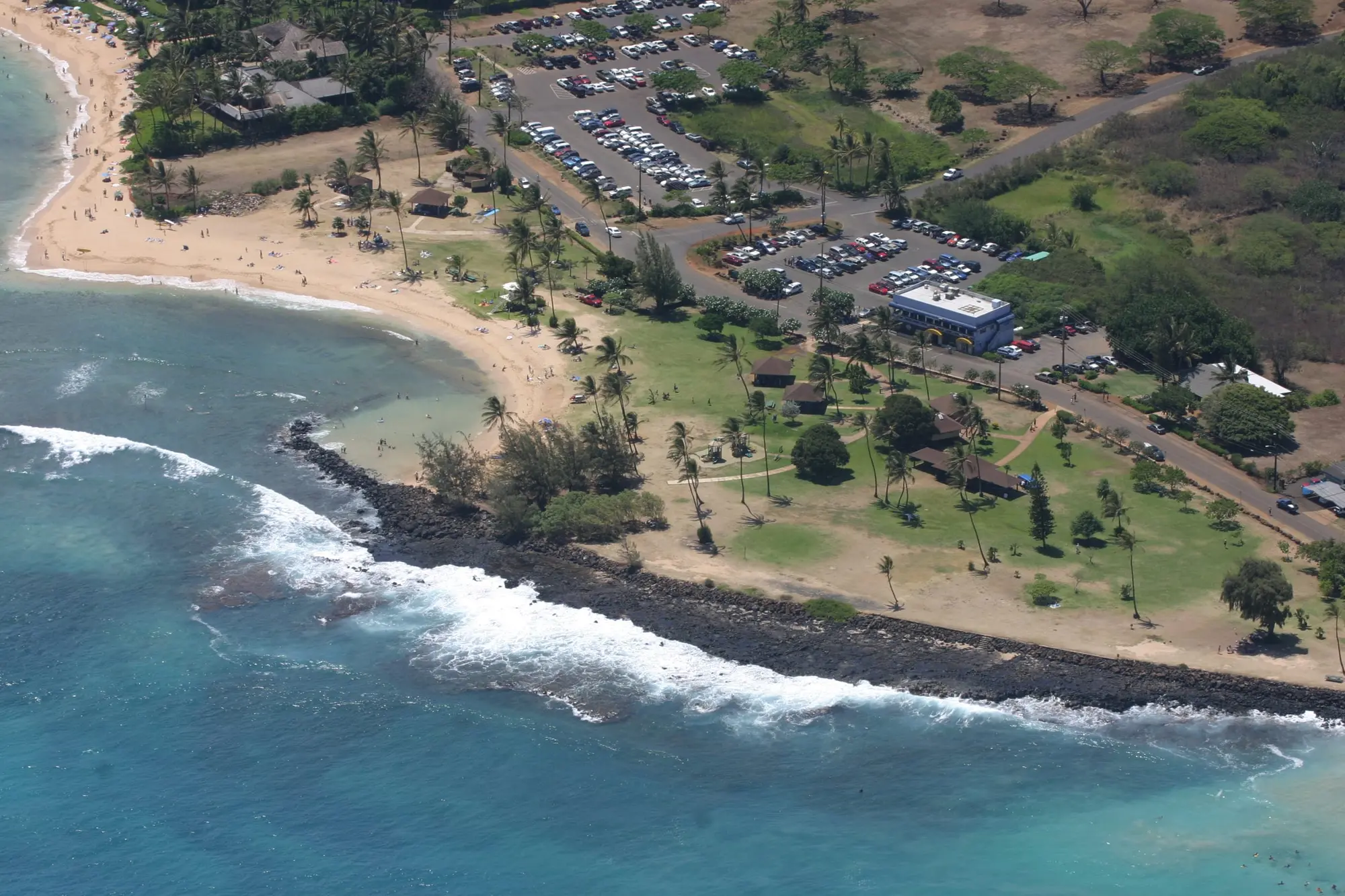
- The wading pool. In front of the park a small boulder breakwater holds a shallow, protected pool, which the lifeguards call the kiddy pond. It is the place on this beach for small children, and the photograph at the top of this page, taken from the air in 2007, shows the wall and the pool behind it.
- Nukumoi Point. In the middle of the beach a sandbar, a tombolo, joins the sand to a shallow rock islet. At low tide it is out of the water, and on either side of it the bottom slopes to overhead depth. This is where the snorkelers go. The sandbar comes and goes with the storms: a big one out of the east washed it out in 2006.
- Brennecke’s. The small beach at the east end is named for Dr. Marvin Brennecke, whose house stood above it until Hurricane Iwa destroyed it in 1982. Its shorebreak is dangerous, and the next section says why it is not the place to swim.
Behind the sand are restrooms, showers, pavilions, picnic tables, barbecue grills and a playground on the grass, with restaurants and a surf shop that rents snorkel gear close by.
After Hurricane Lowell’s surf in September 2026, the county closed the park on 5 and 6 November to put displaced sand back on this beach and remove tree roots the storm had left unstable, and on 9 November it announced another day’s closure, for more sand, on 12 November. What is open on Kauaʻi says whether anything on this beach is still shut.
Who is watching: the towers, and Brennecke’s
The county staffs two towers here, the only beach on the south shore with two. The Poʻipū tower, the larger and older, watches the wading pool. The Nukumoi tower, added in 2018 with the lifeguard association’s support, watches most of the snorkelers, surfers and swimmers, and, in the association’s words, has “the highest first aid treatment of the other towers combined.” Both are scheduled from 8 a.m. to 6 p.m. every day, the hours every county tower has kept since 1 May 2024, and the state Health Department’s list of guarded beaches says the same. A dawn swim or a sunset swim is an unguarded one. If you need help and the tower is empty, the state’s instruction is to call 911.
Brennecke’s is the exception, and the sources disagree about it. The lifeguard association’s tower notes say the Poʻipū tower looks over Brennecke’s as well. The shoreline safety board at Brennecke’s itself, made with the association’s endorsement and photographed there in February 2023, says the opposite, under the heading “WARNING-NO LIFEGUARD”: “The lifeguard stand is a long way from Brennecke’s. They cannot see you.” Its second panel: “Powerful waves at Brennecke’s have caused many serious neck and spinal injuries.” We go by the board. Treat Brennecke’s as an unguarded beach, and swim in front of the towers.
Safe Beach Day, the hazard site the county links to, lists jellyfish, sharks, sharp coral and strong currents at Poʻipū, and rates the water through the day. The guard in the tower is the better answer: conditions change daily, and the lifeguards’ own advice is to ask them before you go in. Kauaʻi ocean safety has every guarded beach on the island and what the warning signs mean.
Snorkeling
The lifeguard association calls Poʻipū “some of the best snorkeling in Kauai,” at a beach with a guard, and that pairing is the reason to start here. Snorkel beside the Nukumoi sandbar, where the sand gives way to reef and the bottom drops away, in front of the Nukumoi tower, which watches most of the snorkelers. In the lifeguards’ words: “because conditions change daily, you should always ask one of us where the best place to snorkel is. And always snorkel with a buddy.”
It is shore snorkeling over a busy reef, not a boat trip to an empty one. Snorkeling tours on Kauaʻi has the guided shore snorkels and the boats that run along this coast, and in summer, when the North Shore is calm, the reef at Tunnels is the island’s other famous shore snorkel.
Monk seals and turtles
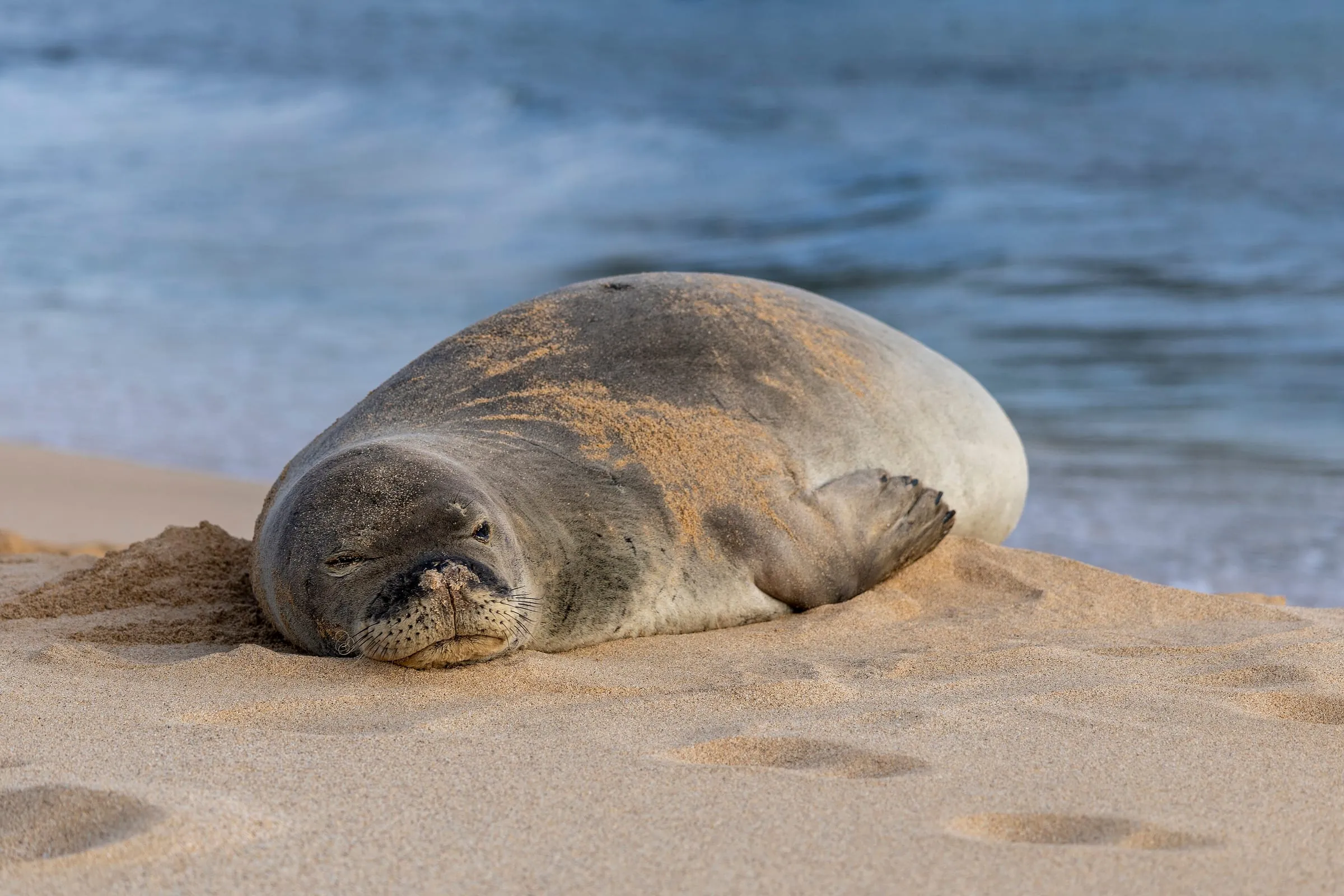
Hawaiian monk seals come ashore on Poʻipū’s sand to rest. The photograph below was taken on this beach in February 2026. They are among the most endangered seals in the world: NOAA counts about 1,600, and only about 400 of them in the main Hawaiian Islands. A seal lying still on the sand is not stranded. Monk seals usually sleep on beaches, sometimes for days at a time, and the state’s wildlife biologists call it hauling out.
The distances. NOAA’s guideline is at least 50 feet from a monk seal, on land and in the water, and 150 feet from a mother and her pup. To judge it, hold a thumbs-up at arm’s length: if your thumb covers the whole seal, you are about 50 feet away. Stay behind any rope, signs or barriers around a seal, and never let a dog near one: NOAA asks for dogs on a leash, and counts dog attacks among the threats to the seals.
Pups. Monk seals give birth from March to August at their peak, some of them on popular beaches, and mother and pup stay on the sand for the five to seven weeks she nurses it, fasting the whole time. Mothers are, in NOAA’s words, famously defensive. Disturbing a seal is against federal and state law, with fines and even jail behind it.
Green sea turtles come out to rest on this sand too. NOAA’s distance for a turtle is 10 feet, on land and in the water. For a seal or turtle that looks sick, hurt or tangled, NOAA’s Marine Wildlife Hotline is (888) 256–9840.
Winter on the south shore
Poʻipū faces away from the winter swells. The state’s surf calendar gives south shores flat-to-small waves from November through April, the months the North Shore takes its biggest surf, and large south swells in summer, which is when the Nukumoi tower’s surfers get their season. Small surf is the rule in winter, not a promise for every day, which is why the guard is still the first person to ask.
It is drier, too, though not dry. The Weather Service’s averages give Poʻipū about 35.6 inches of rain a year against Hanalei’s 86.4, and in December 4.1 inches against 8.5. The best time to visit Kauaʻi has every month, side by side.
NOAA’s humpback whale sanctuary puts the whales in Hawaiian waters from November to April, or to May, with most of them here from January through March. Whale watching on Kauaʻi has the boats and the best headlands, and Kauaʻi from December to March the rest of the season.
Getting here, and parking
Poʻipū Beach Park is about half an hour’s drive from Līhuʻe Airport on a clear road, and 10 minutes from Kōloa town; getting around Kauaʻi has the drive table and the car.
Parking is free, in the county lot on Hoʻone Road at Hoʻowili Road, beside the park. In January 2022 the county council named Poʻipū, Lydgate and Black Pot as the beach parks where visitors would pay to park, with Kauaʻi residents exempt; the fee proposed then was $10 a car. The county has not started charging one.
Spouting Horn, the blowhole on Lāwaʻi Road, is 3.2 miles and 10 minutes west. The road there passes Kukuiʻula Small Boat Harbor; what the storm closed along it is on What is open on Kauaʻi.
Staying near the beach
Booking.com files Poʻipū’s resorts under Kōloa, so its Kōloa list, below, carries hotels and condos along the Poʻipū coast, and a few places in Līhuʻe and Kapaʻa, with what has rooms for your dates.
For a whole house: Poʻipū’s resort area comes in pieces, and a house outside them may rent to visitors only with a TVNC, the county’s nonconforming-use certificate. Is that Kauaʻi vacation rental legal? explains the test, and where to stay on Kauaʻi sets Poʻipū against the North Shore and the east side.