

The short answer: May or September. Both fall in Kauaʻi’s dry season, May to September, when the North Shore’s sea is at its calmest and the water is warm, and both miss the summer and holiday crowds. In 2025 the island’s hotels averaged $389 a night in May and $383 in September, against $490 in December. Winter is the season for humpback whales, here from November to April or May by NOAA’s sanctuary, for the North Shore’s big surf, from October to April, and for a swim on the south shore. No month is dry everywhere, and the side of the island you sleep on decides as much as the month.
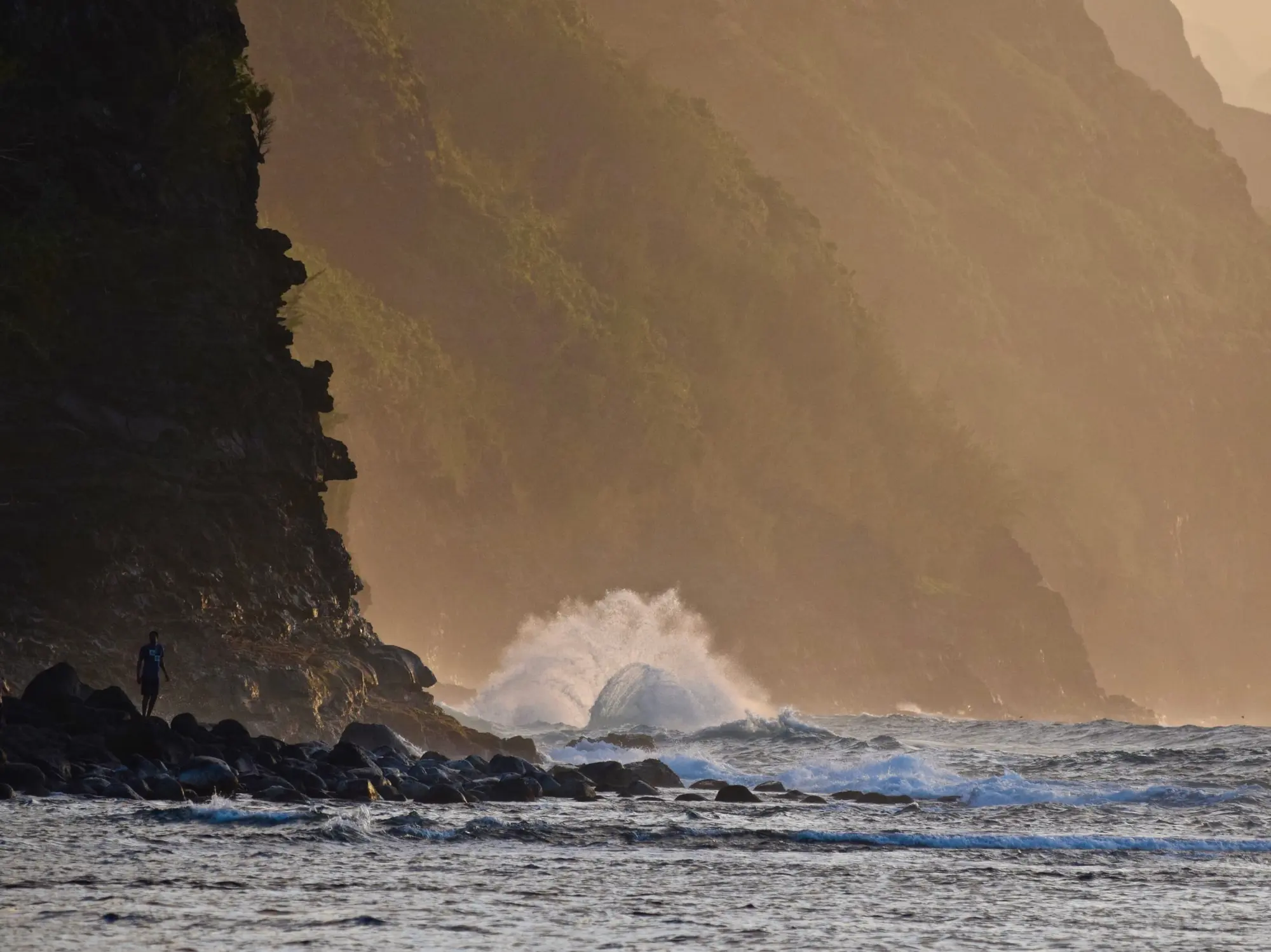
Kauaʻi has no empty season either. In 2025 its hotels were between 70 and 80 percent full in every month, and even in the quietest, September, about 21,000 visitors were on the island on an average day. Below are the numbers, the island side by side, and what each month brings. The photograph at the top is Keʻe, at the end of the North Shore road, where the surf breaks below the first of the Nā Pali cliffs.
The year in one table
Air and rain are NOAA’s 1991–2020 normals for Līhuʻe Airport, on the east side. The sea is NOAA’s monthly average at its Nāwiliwili Harbor station. Sunset is the US Naval Observatory’s time at Līhuʻe on the 15th, in Hawaiʻi time, which does not change in summer.
| Month | High / low °F | Rain, in | Sea °F | Sunset, p.m. |
|---|---|---|---|---|
| Jan | 79 / 66 | 2.8 | 78 | 6:15 |
| Feb | 78 / 66 | 3.6 | 77 | 6:35 |
| Mar | 79 / 67 | 5.6 | 77 | 6:47 |
| Apr | 80 / 70 | 2.0 | 78 | 6:57 |
| May | 82 / 71 | 2.2 | 80 | 7:10 |
| Jun | 83 / 73 | 1.8 | 81 | 7:22 |
| Jul | 85 / 75 | 1.8 | 82 | 7:24 |
| Aug | 85 / 75 | 2.3 | 83 | 7:08 |
| Sep | 85 / 75 | 2.2 | 83 | 6:41 |
| Oct | 84 / 74 | 3.3 | 82 | 6:12 |
| Nov | 81 / 71 | 4.0 | 81 | 5:55 |
| Dec | 79 / 69 | 4.6 | 79 | 5:57 |
Read down the rain column and the wet months stand out, though April is already dry at Līhuʻe. The National Weather Service counts May to September as the dry season and October to April as the wet one, and at Līhuʻe the rain goes from about 2 inches a month in summer to 4 to 5.6 in November, December and March. The air barely moves: highs from 78°F in February to 85°F from July to September, and nights from 66°F to 75°F. The sea runs from 77°F in February and March to 83°F in August and September. The days do change, from 10 hours 48 minutes of daylight on 21 December to 13 hours 29 minutes on 21 June.
Rain, by side of the island
The trade winds blow from the northeast most of the year and drop their rain on the windward North Shore and east side and on the mountains in the middle. The south and west lie in their lee. The Weather Service’s monthly averages for four of its gauges, one on each side, in inches:
| Month | Hanalei, North Shore | Līhuʻe, east | Poʻipū, south | Port Allen, west |
|---|---|---|---|---|
| Jan | 7.6 | 2.8 | 4.2 | 3.8 |
| Feb | 7.3 | 3.6 | 3.2 | 2.6 |
| Mar | 8.7 | 5.6 | 3.9 | 3.3 |
| Apr | 7.6 | 2.0 | 2.6 | 1.4 |
| May | 6.5 | 2.2 | 2.0 | 1.3 |
| Jun | 5.1 | 1.8 | 1.7 | 0.8 |
| Jul | 6.6 | 1.8 | 1.8 | 0.9 |
| Aug | 6.5 | 2.3 | 2.0 | 0.9 |
| Sep | 6.2 | 2.2 | 2.2 | 1.1 |
| Oct | 6.5 | 3.3 | 3.4 | 2.7 |
| Nov | 9.3 | 4.0 | 4.4 | 3.3 |
| Dec | 8.5 | 4.6 | 4.1 | 3.7 |
| Year | 86.4 | 36.2 | 35.6 | 25.6 |
- The North Shore takes the most, every month. Hanalei averages 86.4 inches a year, and its driest month, June, at 5.1 inches, is wetter than Poʻipū’s wettest, November, at 4.4. Its wettest months are November, March and December.
- Poʻipū and Līhuʻe get about the same over a year, about 36 inches, but not in the same months: Poʻipū is the wetter of the two in January and the drier in March. Each gets well under half of Hanalei’s rain.
- The west side is the driest. Port Allen, where the Nā Pali boats leave, averages 25.6 inches a year and under an inch a month from June to August. NOAA’s normal for Barking Sands, on the far west shore, is 17.8.
- Up the canyon it is wetter, and cool. At the Kōkeʻe State Park headquarters, about 3,600 feet up Waimea Canyon Drive, NOAA’s normals give 57 inches of rain a year, 9.6 in December and about 2 a month from June to September, with January days at 65°F and nights of about 48°F. Bring a layer for the lookouts; Waimea Canyon and Kōkeʻe has the drive and the trails.
- The middle of the island is in a class of its own. The Weather Service’s monthly averages for the US Geological Survey’s gauge near the summit of Mount Waiʻaleʻale add up to almost 394 inches a year.
The sea: north in winter, south in summer
Kauaʻi’s surf follows the seasons. From October through April the big swells come out of the north and northwest onto the North Shore. From May through September the south shore gets the summer’s south swells. The Weather Service’s Honolulu office issues a high surf advisory for north-facing shores at 15 feet and a warning at 25, against 10 and 15 for south-facing shores, measured on the full face of the wave.
- The North Shore is summer’s side. The island’s lifeguards call summer generally the safest time to swim at Hāʻena Beach Park, beside Tunnels, and in winter often too dangerous to swim. Go Hāʻena, the reservation site for the park at the end of the road, tells visitors to Keʻe to “Expect rougher conditions and more rain October through April.” In winter Hanalei Bay is a surf break, with big waves and strong currents at Pine Trees, Waiʻoli Beach Park.
- The south shore is winter’s side for a swim. It faces away from the winter swells, so Poʻipū Beach, with its lifeguard towers, is the place to swim and snorkel in winter. In summer the south swells bring Poʻipū its surfing season.
- The west end takes both. The lifeguards at Kekaha see the northwest swells of winter and the south swells of summer.
Whatever the month, swim where a lifeguard is on duty and ask before you go in: Kauaʻi ocean safety has the guarded beaches and what the warnings mean, and snorkeling tours on Kauaʻi sorts the reefs by season.
Crowds and hotel rates
Kauaʻi had about 1.41 million visitors in 2025. The state’s count of how many were on the island on an average day, and STR’s monthly averages for its hotels, as the state publishes them:
| Month, 2025 | Visitors on an average day | Hotel rate, a night | Hotel rooms filled |
|---|---|---|---|
| Jan | 28,700 | $416 | 77% |
| Feb | 28,500 | $415 | 80% |
| Mar | 30,800 | $418 | 77% |
| Apr | 29,600 | $415 | 77% |
| May | 27,900 | $389 | 74% |
| Jun | 33,300 | $435 | 77% |
| Jul | 33,800 | $441 | 77% |
| Aug | 28,300 | $427 | 75% |
| Sep | 21,000 | $383 | 74% |
| Oct | 24,200 | $384 | 76% |
| Nov | 27,300 | $384 | 70% |
| Dec | 29,200 | $490 | 70% |
The island is busiest in June and July, when about 33,000 visitors are here on an average day, and quietest in September and October. The lowest hotel rates are September to November and May; the highest is December, with the holidays. Hotels stay between 70 and 80 percent full all year: Kauaʻi has a quiet season, but not an empty one.
These are 2025’s figures because 2026 is no guide to a normal year. In September 2026, the month Hurricane Lowell struck, Kauaʻi had 35 percent fewer visitors than a year before and its hotels were 47 percent full. What a whole week adds up to, with the room taxes, the car and the park fees, is on what a week on Kauaʻi costs.
Month by month
January to March. The heart of whale season and of the North Shore’s big-surf winter. These are the peak months for humpbacks by NOAA’s humpback whale sanctuary, and the boats that go out for them are on whale watching on Kauaʻi. January is the driest of the three at Līhuʻe, 2.8 inches, and March the wettest, 5.6, and these are the year’s coolest nights, about 66°F. Hotels averaged $415 to $418 a night, and March was the busiest month outside June and July. This winter’s dates, the holidays and the days Hāʻena’s holiday reservations go on sale are on Kauaʻi from December to March 2027.
April and May. The seasons turn. Līhuʻe’s rain drops to about 2 inches a month, the North Shore’s winter swells ease, and the whale season winds down: NOAA’s sanctuary ends it with April on its home page and with May in its boating guidelines. May is the pick of the spring: in 2025 it had fewer visitors than any month but September, October and November, about 27,900 on an average day, and the lowest hotel rate outside them, $389. April averaged $415.
June to August. Summer, and the dry stretch of the year almost everywhere: under 2.5 inches of rain a month at Līhuʻe and Poʻipū, and under an inch at Port Allen. The North Shore’s sea is at its calmest, the reefs at Tunnels and Keʻe are at their best, the sea reaches 81°F to 83°F, and the sun sets at about 7:24 p.m. in mid-July. It is also the busiest season, about 33,300 visitors a day in June and 33,800 in July, with hotels at $435 and $441, and the state warns that its Nā Pali camping permits “often sell out months in advance, particularly during the summer.” Hurricane season starts on 1 June.
September and October. The quiet months. September 2025 had the fewest visitors of the year, about 21,000 on an average day, and the lowest hotel rate, $383; October followed at about 24,200 and $384. The sea is at its warmest, 83°F, and through September the North Shore keeps its summer sea. From October the winter swells start and the rain comes back, 3.3 inches at Līhuʻe. The catch is the hurricane season: ʻIniki in 1992 and Lowell in 2026 both struck in September.
November. Wet and changeable: the North Shore’s wettest month, 9.3 inches at Hanalei, and 4 to 4.4 at Līhuʻe and Poʻipū. The winter swells are in, the whale season begins, hotels averaged $384 and were 70 percent full, and the hurricane season ends on the 30th.
December. The holidays: the year’s highest hotel rate, $490 a night on average in 2025, 8.5 inches of rain at Hanalei, and the short days, with sunset at about 5:57 p.m. on the 15th. The whale season is under way, and Christmas and New Year’s on Kauaʻi are on the December-to-March page.
Hurricane season
The Central Pacific hurricane season officially runs from 1 June to 30 November, and the Central Pacific Hurricane Center adds that tropical cyclones “can and do occur year round.”
Kauaʻi’s hurricanes have all come from August on. After ʻIniki, the Weather Service’s survey of the storm listed the recent hurricanes that had damaged Hawaiʻi, and every one had passed closest to Kauaʻi: Nina in November and December 1957, Dot in August 1959, ʻIwa in November 1982, and ʻIniki itself on 11 September 1992, whose eye crossed the island from Waimea to Hāʻena in under an hour that afternoon. On the night of 7 September 2026 Hurricane Lowell passed about 35 miles west of Niʻihau as a Category 2. The Weather Service’s report on it records catastrophic damage in Kauaʻi County, worst on the south and west shores, where at Poʻipū the waves and storm surge swept cars and homes off their foundations.
What that means for a trip:
- Between August and November, book what you can cancel, and watch the Central Pacific Hurricane Center’s outlook in the week before you fly.
- A storm’s damage outlasts it. The state was still reopening Kauaʻi’s parks in stages two months after Lowell. What is open on Kauaʻi has every park, harbor and road since the storm, each with its date, and is the page to check before you plan around one.
This winter: El Niño
On 22 October 2026 the Weather Service’s Honolulu office said El Niño had reached the very strong category, and that the climate models favor “unusually high probabilities for below normal rainfall statewide through early spring 2027.” If that holds, it expects drought to develop in many areas in the second half of the winter. It added a warning that matters on an island of flash floods: “Flash flooding can still happen within a drought.” So this winter may run drier than the averages above, but not safer. Kauaʻi from December to March 2027 has the rest of the outlook.
What sells out, and what to plan around
- Hāʻena State Park, for Keʻe Beach and the first two miles of the Kalalau Trail, takes visitors by reservation every day of the year: anyone without a Hawaiʻi ID the park accepts needs one. Each date goes on sale 30 days ahead at midnight Hawaiʻi time, and Go Hāʻena says its parking and entry reservations sell out immediately. Hāʻena State Park reservations has how each kind sells.
- Camping on the Kalalau Trail goes first in summer, the state warns. Kalalau Trail permits has the permit and when it opens.
- The holidays cost the most. December’s hotel average, $490, was 2025’s highest, though its hotels were 70 percent full.
- The whale boats sail only in season, and whale watching on Kauaʻi has when each one runs.
So when should you go?
- For the North Shore, its beaches, its reefs and the Kalalau Trail: May to September, when its sea is calmest. Book Hāʻena the night your date opens.
- For whales: January to March, the peak by NOAA’s sanctuary; the shared whale boats run from December, on whale watching on Kauaʻi.
- For a winter swim: the south shore, Poʻipū and Kōloa, which faces away from the winter swells.
- For the lowest hotel rates and the fewest people: September to November, accepting hurricane season and, from October, the rain and the winter surf; or May, at $389 the cheapest month outside them.
- For Waimea Canyon and Kōkeʻe: June to September, the canyon’s dry months, at about 2 inches of rain a month at Kōkeʻe.
Which side to sleep on, and the county’s rule on which homes may rent to visitors, are on where to stay on Kauaʻi. Booking.com’s lists for Poʻipū and the east side, and two Princeville resorts, are at the foot of this page, with Viator’s full list of Kauaʻi trips.
Every figure on this page was read from NOAA, the National Weather Service, the Central Pacific Hurricane Center, the US Naval Observatory, the state’s tourism statistics and the state parks’ own pages on 11 November 2026.


