
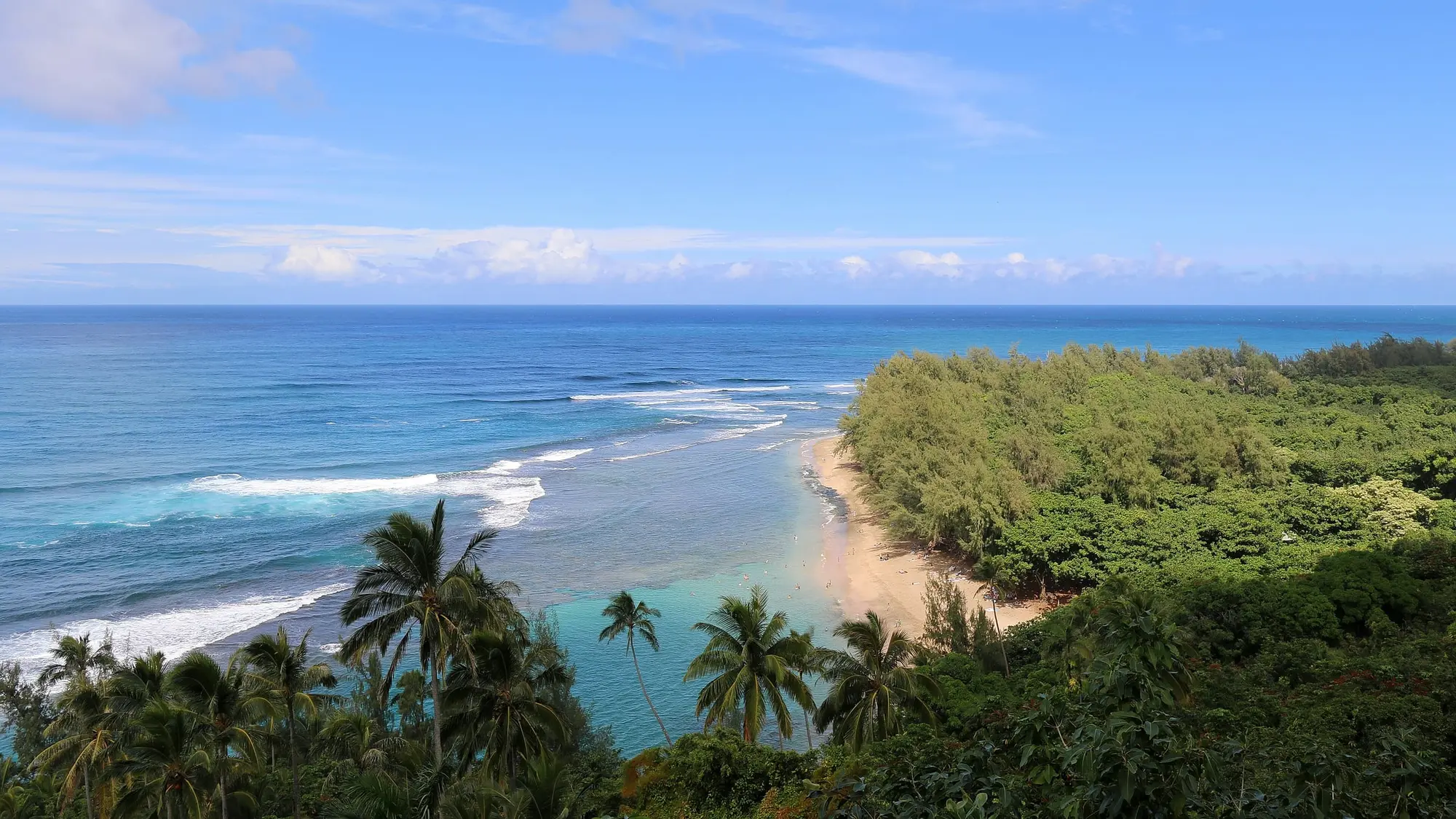

Keʻe Beach is where the road ends. Kūhiō Highway runs out at the western edge of Hāʻena State Park, on the North Shore, and past the sand the coast becomes the Nā Pali cliffs, with the Kalalau Trail climbing away from the end of the beach. Offshore, a narrow fringing reef closes in at its western end to make a lagoon, a sand-floored pool sheltered from the open sea, with a county lifeguard tower beside it.
It is a beach with rules. Keʻe is inside a state park that admits visitors by reservation only, bought online before you arrive. And it faces north, into winter’s swells, so from October to April the lifeguards close the water on the worst days. Below are the lagoon and when it is safe, the parking and the shuttle, the winter sunset, and the sacred ground above the beach, as each stood on 11 November 2026. Whether the park is open on your dates is on what is open on Kauaʻi.
The lagoon
The park’s master plan, approved by the state in 2018, describes Keʻe’s swimming area as “a large sand pocket protected by the surrounding platforms of fringing reef.” On a calm day you wade in from the sand into shallow, sheltered water, with the lifeguard watching. Safe Beach Day, the conditions site the county’s ocean safety notices point to, calls Keʻe the most popular snorkeling site on the North Shore, and names the fish: wrasses, butterflyfish, damselfish, goatfish, convictfish and surgeonfish.
It is an easy snorkel rather than a rich one. In a snorkel survey for the master plan in November 2008, biologists counted 80 fish species along Kauaʻi’s North Shore and 46 of them inside the lagoon. The studies the plan draws on found far more variety on the seaward side of the reef, with more than 160 species recorded off Limahuli Stream and in Hanalei Bay, and the seaward side is where a snorkeler from the beach should not go. The crowds have cost the coral: the plan puts live cover “between four to 47 percent in some areas due to large amount of visitor traffic.” Go Hāʻena, which runs the park’s reservations, puts the swimmer’s part in two lines: “Use reef safe sunscreen. Do not approach animals or stand / walk on reef.”
Turtles and monk seals. Green sea turtles graze in the shallows of the North Shore, these included, and the plan records Hawaiian monk seals as frequently seen at Hāʻena, with both known to haul out on the sand between Keʻe and Limahuli Stream. Since 2015 the whole shoreline in front of the park has been critical habitat for the seals. NOAA’s distances: at least 10 feet from a turtle and 50 feet from a monk seal, on land and in the water, and 150 feet from a mother and pup.
Outside the lagoon, the plan would allow only walking, sunbathing and sightseeing along the shore, since the lifeguards cannot watch it and the seals use it. The North Shore’s other summer snorkel is Tunnels, back along the road at Hāʻena, and Kauaʻi snorkel tours has the guided snorkels, Poʻipū’s among them for winter.
When the water is safe, and when it is not
Summer is the season. The lifeguard association describes Keʻe’s reef as one “that keeps the water protected and calm when swells are not too large,” and the lagoon as “great for snorkeling during the summer months.” The calm months are May to September: Kauaʻi’s lifeguards and Go Hāʻena both count the rough season from October to April, a month earlier than the state Health Department’s winter, and we go by Kauaʻi’s.
Winter is for checking first. In the association’s words, “In the winter months the swells can get huge and become dangerous, always check with a lifeguard before entering the water and check for any signage about current conditions.” Go Hāʻena’s conditions page says it more briefly:
“Expect rough ocean October to April. Year round, lifeguards may close the beach if unsafe.”
They do. On 5 and 6 November 2026 the county’s Ocean Safety Bureau advised no swimming or other water activities at Keʻe, for high surf and strong currents. A reservation bought a month ahead can land on a day like that, and Kauaʻi ocean safety has the winter rule for the whole North Shore, and where to swim instead.
The channel. The reef is not closed all the way round. When the surf is up, the master plan warns, “a powerful rip current can be generated that runs out of the narrow channel at the west end” of the lagoon “to the open ocean, creating a hazard for swimmers and divers.” The state lists high surf, rip currents, sharp coral, a sudden drop-off and waves breaking on the ledge among the park’s hazards. Stay inside the reef and where the lifeguard can see you, which is the plan’s own advice to anyone new to these waters.
The tower. Keʻe’s lifeguard tower went up in 2007; Hawaiʻi State Parks pays for it and the county runs it. It stands at the end of the road by the Kalalau trailhead, over the lagoon, and it is scheduled from 8 a.m. to 6 p.m. every day, the hours the county keeps at every tower and the state Health Department lists for Keʻe. Before 8 a.m. and after 6 p.m. the lagoon is unguarded. The tower also depends on the road: on 18 June 2026 the county closed the Keʻe and Hāʻena towers for flooding at Mānoa Stream on Kūhiō Highway, and its notice read “Lifeguard services are not available at these locations until further notice.”
Getting in: the reservation, the lot and the shuttle
The reservation. Hawaiʻi residents with a current Hawaiʻi driver’s license or state ID enter free, and a Kalalau camping permit counts as entry. Everyone else buys one of three from Go Hāʻena: a seat on the shuttle, a parking slot, or entry alone at $5 a person. There is no separate beach ticket; each one covers Keʻe, the park and the trail as far as Hanakāpīʻai. Each date goes on sale 30 days ahead at midnight Hawaiʻi time, never at the gate, and the parking usually sells out by 12:01 a.m. The limit is the point: the state holds the park to a daily cap, and its master plan set the first target at an average of 900 visitors a day, hikers included. Hāʻena State Park reservations has every price, how fast each one goes, and what to try when your date is sold out.
The lot. It holds about 100 cars, the figure the lifeguard association gives and the master plan set as its maximum, and the state keeps 30 stalls for Hawaiʻi residents, first come, first served. A parking reservation buys one car one time slot, from 6:30 a.m. to 12:30 p.m., from 12:30 to 5:30 p.m., or from 4:30 p.m. to sunset, and a longer day takes the next slot as well. Go Hāʻena, which sells the slots, charges $20 a car for each one plus $5 a person; the state’s park page and its October reopening notice still say $10 a vehicle. We budget the $20. The lot opens at 6 a.m. and the park at 7 a.m., and on its winter hours it closes at 6:45 p.m., every day, holidays included.
Never park outside the park. The state fines a car on the road shoulder $200, and Go Hāʻena’s terms bar park visitors from parking outside it, with “Parking tickets are $200+ and cars can be towed from nearby destinations.” That covers the county lot at Hāʻena Beach Park, by Tunnels, for anyone headed into the state park. We keep Tunnels by car to a day with no reservation. The one lot outside the park where Go Hāʻena has day visitors park is the shuttle’s, at Waipā, below.
The walk. From the lot or the shuttle drop-off to the sand is about a third of a mile: 0.33 mile by Go Hāʻena’s conditions page, 0.4 by its accessibility page, on a boardwalk and unpaved path, and the way onto the beach is down what it calls “a fairly steep embankment.” There are ADA spaces beside the beach, the trailhead and the restrooms, for a car with a placard and a parking reservation or a Hawaiʻi ID. The gate to them is locked at 5:30 p.m. from October to April and at 6 p.m. from May to September.
The shuttle. The Kauaʻi North Shore Shuttle leaves from Waipā Park & Ride in Hanalei through the morning, and from Princeville at 7 and 9 a.m. Riders park free at Waipā, the one stop where they may park. Its ticket includes park entry, and you must ride it. It takes small beach gear, snorkel gear, folding chairs and umbrellas, and nothing large, such as a surfboard or a big cooler. On the winter schedule the last pick-up at the park is at 5:40 p.m.
The drive. Keʻe is 37.6 miles from Līhuʻe Airport, about an hour and a quarter on a clear road, and past Princeville the road crosses the one-lane Hanalei Bridge, which closes when the river floods. Getting around Kauaʻi has the drive and the bus, which stops short of Hāʻena, and what is open on Kauaʻi the bridge.
Sunset at the end of the road
Keʻe sits at the foot of the Nā Pali, and in winter a sunset there cannot be done on the shuttle. The last shuttle leaves the park at 5:40 p.m., and the sun never sets that early at Keʻe: by the US Naval Observatory it goes down at 5:53 p.m. at its earliest, at the end of November, at 6:06 p.m. on 31 December and at 6:27 p.m. on 31 January. The way to stay is the evening parking slot, which runs from 4:30 p.m. to sunset, and the state asks cars on it to leave shortly after. An entry-only pass does the same for anyone who walks or bikes in.
From 7 March the sun sets at 6:45 p.m. or later, at or after the park’s winter closing time, so on those evenings the closing time comes first. The state’s summer hours begin on 1 April, running to 7:45 p.m. on its park page, and Hāʻena State Park reservations has the summer closing time to plan on.
What to bring, and what the park bars
Nothing is for sale. State park rules bar all commercial activity in Hāʻena, “including tours, sales, services,” so there is no food, no drink and no snorkel, chair or umbrella rental at Keʻe. Bring all of it, and water. Safe Beach Day’s Keʻe page lists gear rental and metered parking, and there is neither: parking is by reservation. What the park has is restrooms, outdoor showers, a drinking fountain and picnic tables, with ironwoods shading the back of the beach.
What it bars. No pets: certified service dogs are welcome, emotional support animals are not. No alcohol, no smoking and no camping, and on the trail Go Hāʻena adds no speakers and no drones.
No signal. The state says to assume there is no internet at or near the park. The reservation arrives by email as a PDF: save it to your phone or print it before you set out.
The sacred ground above the beach
Keʻe is the setting of one of Hawaiʻi’s best-known moʻolelo. Ka Ulu a Paoa, a heiau and school of hula named for Paoa, a chief of Hāʻena and the close friend of Lohiʻau, overlooks the beach from the cliffs above it. The master plan calls it Hāʻena’s most sacred and significant site, and the place where the love affair between Pele and Lohiʻau began. Its highest level is Ke Ahu a Laka, the altar of Laka, the deity of hula, and practitioners still hold ceremonies there. The plan names both wahi kapu, sacred places, “not appropriate for general visitation or recreational use.” They are not a viewpoint or a side trip from the beach.
The sand dunes behind the beach hold ancestral burials, and the plan puts their restoration among its first efforts; keep to the paths. The park holds dozens of archaeological sites besides, and Go Hāʻena’s rule covers all of them: “Archaeological sites are protected by law. Do not pick up rocks, sit on, or disassemble rock walls.”
The people who look after the park are from here. Hui Makaʻāinana o Makana, a nonprofit formed by lineal descendants of Hāʻena, manages access under an agreement with State Parks, with The Hanalei Initiative running the reservations and the shuttle. The access fees support the Hui’s farm management and youth programs, and its volunteers are restoring about 15 acres of the park, its loʻi kalo, the taro fields, among them.
The Kalalau Trail starts here
The trailhead is at the end of the road, beside the tower. The first 2 miles, to Hanakāpīʻai Beach, are 4 miles there and back, three to four hours by Go Hāʻena’s reckoning, and the waterfall up the valley makes it 8 miles and six to eight hours, with stream crossings that flash-flood. The Hāʻena reservation covers both; past Hanakāpīʻai the trail takes a Kalalau camping permit, even for a day. Swim at Keʻe, after the hike or before it: Go Hāʻena’s rule is to enter the ocean only here, never at Hanakāpīʻai, where the state warns that drownings occur regularly. Kalalau Trail permits has the hike and its rules.
Past the end of the road
No road goes on from Keʻe, and no tour may operate inside the park, so every trip along this coast starts somewhere else. From the sea, the Nā Pali boats leave from the west side or, a few of them, from Hanalei Bay (Nā Pali Coast boat tours); from the air, the helicopters; and the Nā Pali by boat, by air or on foot compares the three. Along the North Shore, Hanalei Bay is the long beach in town, where on 5 and 6 November the county allowed swimming at the pavilion tower and the pier while it advised none at Keʻe. Viator’s full list of Kauaʻi trips is at the foot of this page.
Where these facts come from
- The Division of State Parks: its Hāʻena State Park page and the facilities, hazards and rules it lists, its Hāʻena and Nā Pali Coast access page and FAQ, its Kalalau Trail page, and the park’s master plan, approved in 2018.
- The Department of Land and Natural Resources: its release of 13 October 2026 reopening the park.
- Go Hāʻena: its information and FAQ page, its conditions, accessibility, shuttle and about pages.
- The County of Kauaʻi: its Ocean Safety Bureau’s notices of 23 April 2024, on the towers’ hours, and of 18 June, 5 November and 6 November 2026.
- The Kauai Lifeguard Association, the state Health Department’s list of lifeguarded beaches and its surf seasons page, and Safe Beach Day.
- NOAA Fisheries, for the wildlife distances, and the US Naval Observatory, for sunset at Keʻe.
- OpenStreetMap routing, for the drive from the airport, by way of getting around Kauaʻi.
Every figure on this page was read against them on 11 November 2026.


