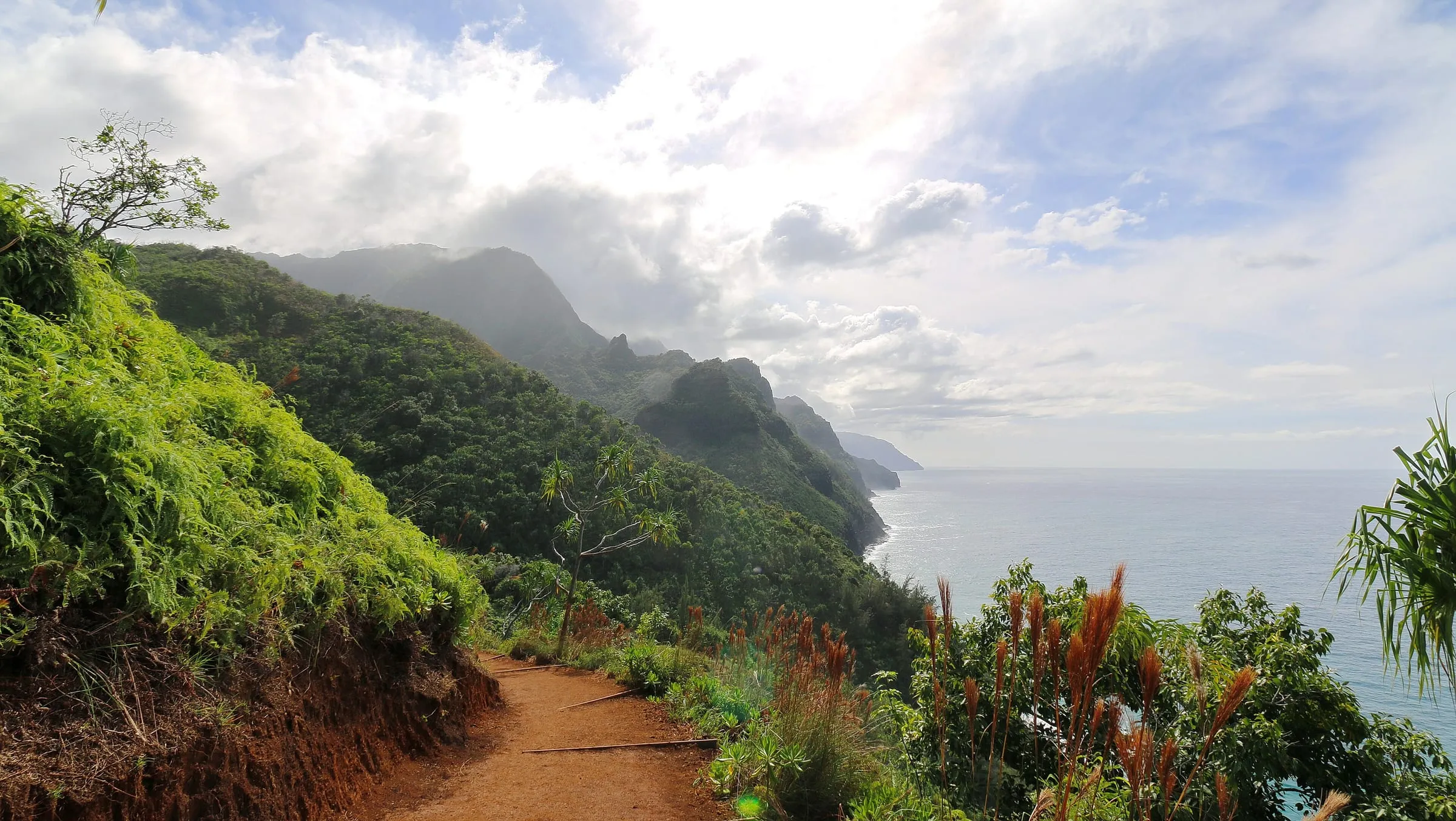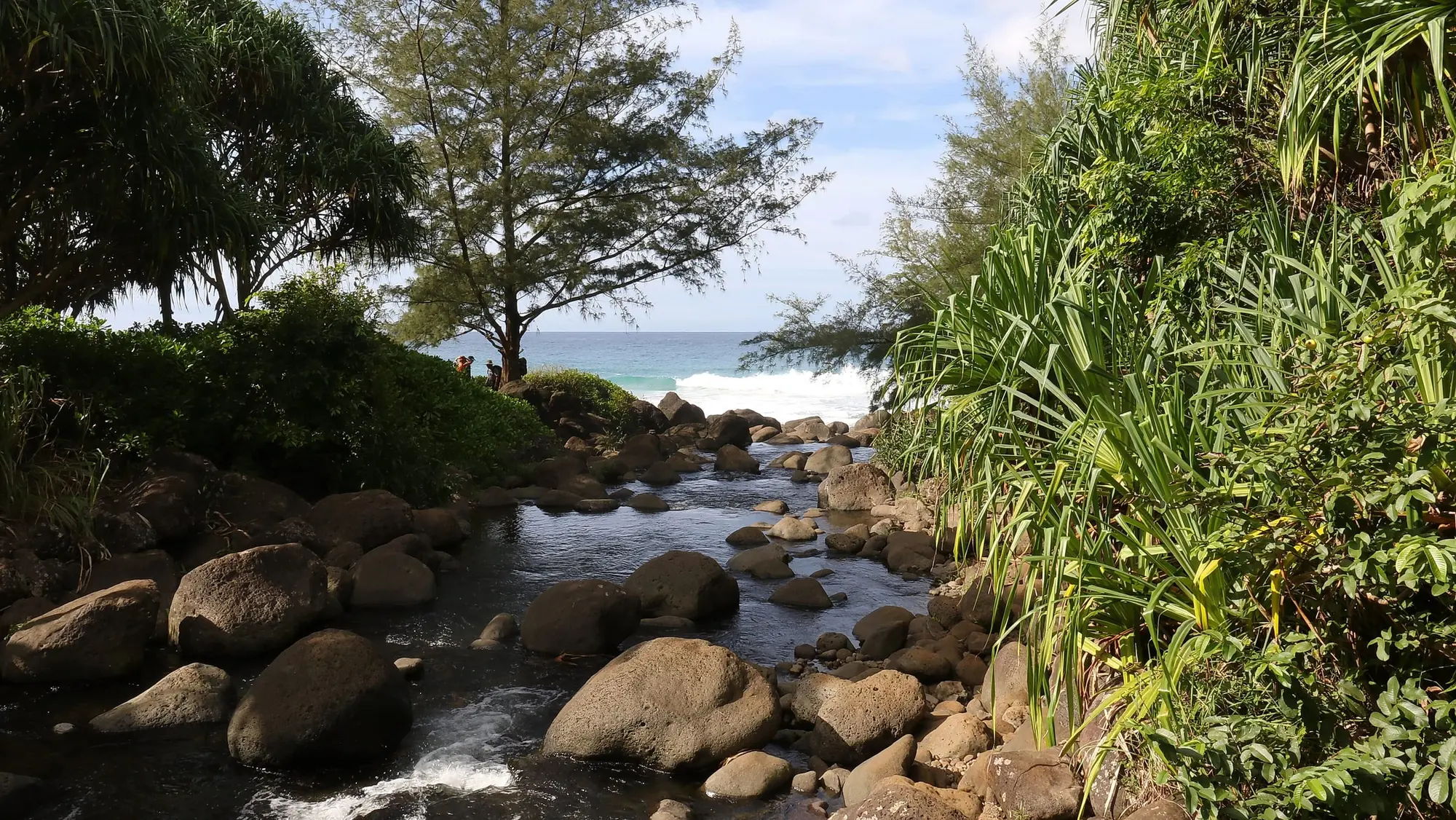
The Kalalau Trail starts at Keʻe Beach, at the end of the road on the North Shore, and runs 11 miles along the Nā Pali cliffs to Kalalau Beach. Two different permits govern it, and which one you need depends on how far you go. The first 2 miles, to Hanakāpīʻai, are a day hike covered by the reservation that gets you into Hāʻena State Park. Beyond Hanakāpīʻai the rule is the state’s, and it is short:
“Anyone proceeding beyond Hanakāpīʻai MUST possess a valid camping permit.”
That holds even if you plan to turn around at noon. Go Hāʻena, which sells the park’s reservations, puts it the same way: “Kalalau camping permits are required to hike PAST Hanakāpī’ai Valley along the coast, even just for a day hike.” Below is each permit as it stood on 11 November 2026, what it costs and when it goes on sale, how to get a car to the trailhead and leave it there, and the places where the state’s own pages disagree, with the version we go by. Whether the trail is open on your dates is on what is open on Kauaʻi.
How far you go decides the permit
| Where you turn back | There and back | Time | What you need |
|---|---|---|---|
| Hanakāpīʻai Beach, 2 miles in | 4 miles | 3 to 4 hours | A Hāʻena State Park reservation, or a Hawaiʻi ID |
| Hanakāpīʻai Falls, 2 miles up the valley from the beach | 8 miles | 6 to 8 hours by Go Hāʻena; the state says to allow a full day | The same Hāʻena reservation |
| Hanakoa, about 6 miles in | About 12 miles | 8 hours or more, for experienced hikers in excellent shape | A Kalalau camping permit, even for the day |
| Kalalau Beach, 11 miles in | 22 miles | A full day each way | A Kalalau camping permit and at least one night |
The state is plain about the whole trail in a day: “Those without camping permits for Kalalau Valley are therefore prohibited from attempting the entire 22-mile round trip hike in a day.” It does not recommend day hikes beyond Hanakoa even with a permit.
The day hike to Hanakāpīʻai
What it takes. A Hāʻena State Park reservation of any of its three kinds, a shuttle seat, a parking slot or entry alone, from Go Hāʻena. Every one includes Keʻe Beach and the trail to Hanakāpīʻai Beach and its waterfall. The state sells no hiking permit of its own for this stretch. Hawaiʻi residents with a Hawaiʻi ID need no reservation. Hāʻena State Park reservations has the prices, when each date goes on sale and how fast it goes.
Fitting the hike into a reservation. From the lot or the shuttle drop-off to the trailhead is 0.33 miles. A parking slot is a fixed window: the morning slot runs from 6:30 a.m. to 12:30 p.m., six hours, and the afternoon slot from 12:30 to 5:30 p.m. That is time enough for the beach, at 3 to 4 hours there and back. The falls, at 6 to 8 hours, do not fit in one slot, so a falls hike on a parking reservation takes the morning and the afternoon slots together. The shuttle gives a longer day without a second slot: on the winter schedule the first leaves Waipā at 7:20 a.m., and the last pick-up at the park is at 5:40 p.m.
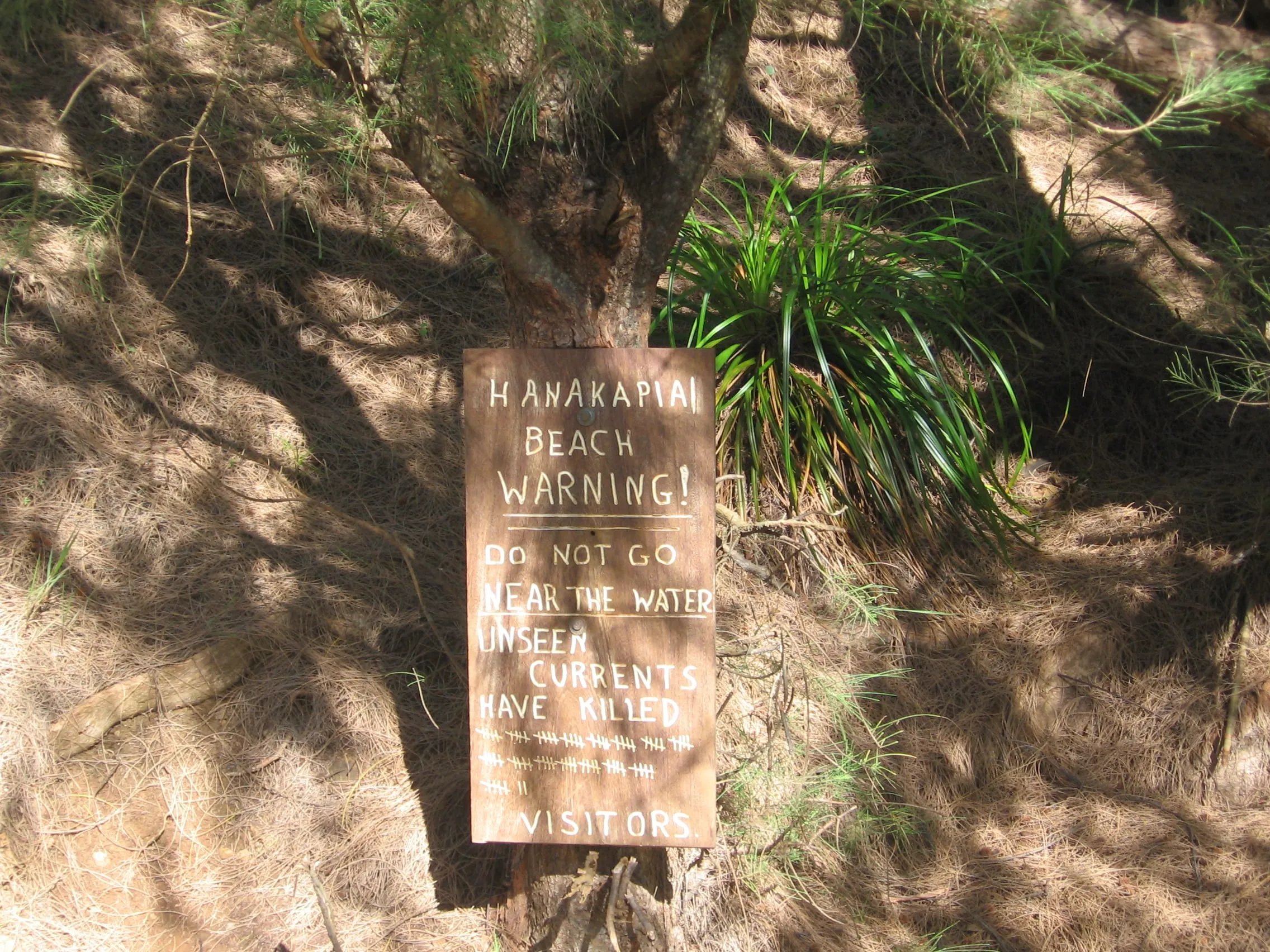
The beach is for looking at. The state’s warning about Hanakāpīʻai Beach is in capitals on its trail page:
“DROWNINGS OCCUR HERE REGULARLY!”
The surf and rip currents there are at their worst in winter, when high surf comes in, and there are no lifeguards. Go Hāʻena’s rule is to go into the ocean only at Keʻe, never at Hanakāpīʻai, and it warns of waves at Hanakāpīʻai that have hit bystanders on the shore. The photograph below is the warning sign that stood at the beach in 2005, with its tally of the visitors the currents had killed. Kauaʻi ocean safety has the winter rule for the whole North Shore.
The falls. Above the beach, an unmaintained trail climbs 2 miles up Hanakāpīʻai Valley to a waterfall. About a mile up it crosses the stream and gets harder, over rocks and fallen trees, and the state says to hike its upper half only in good weather, for flash floods and falling rocks. Go Hāʻena calls the falls hike one for experienced hikers only, with stream crossings and slow going. Kauaʻi waterfalls has the other falls you can reach this winter.
What to bring and leave. Bring extra water and covered shoes, expect wet, muddy rock all year, and leave flip-flops and baby carriers behind; speakers and drones are banned. The steep climbing starts right at the trailhead, and Go Hāʻena calls the trail “VERY DIFFICULT”.
Past Hanakāpīʻai: the Kalalau camping permit
One permit covers everything beyond Hanakāpīʻai. Since 19 May 2010 the state has issued no permits for Hanakoa: a trail permit is a Kalalau permit, and it is also good for a night at Hanakoa, the only other place on the trail where camping is allowed. It is the hiking permit too, “whether or not you choose to camp”, in the state’s words, and it includes entry to Hāʻena State Park, so its holders need no Hāʻena reservation. A Miloliʻi permit does not count for any of this: Miloliʻi, farther down the coast, is reached only from the sea.
What it costs
The fee is $35 a person a night for visitors and $25 a person a night for Hawaiʻi residents, and the state adds a service fee to each permit.
$35, not $30. One state page prints a lower fee: its Permits & Fees page, last edited on 9 October 2020, the day the current fees took effect, gives visitors $30 a person a night. The fee rule itself, the Kauaʻi camping page, the Kalalau Trail page, the special permit rules and the 2025 parks brochure all say $35, and we go by $35.
The service fee: 10%, by the state’s 2025 brochure. The state’s camping rule allows a service fee on every permit, its Permits & Fees page refunds a canceled permit “minus non-refundable service fee”, and its notice on the closures since the September storm refunds reservations “minus nonrefundable service charges.” None of them gives the amount. Its parks brochure of August 2025, made before camping moved to Explore Outdoor Hawaiʻi on 1 February 2026, does, beside the same $35: “10% administrative fee will be added to permit cost.” The Kalalau Trail and park pages list the $35 without it. With the 10%, a visitor pays $38.50 a person a night, and two visitors camping five nights pay $385, before any parking or shuttle.
Per person, not per campsite. The state’s Kalalau Trail page, its Kauaʻi camping page and its special permit rules for the Nā Pali Coast all say per person a night. Its Nā Pali park-info page says “Non-Residents = $35 Per Night, Per Campsite”. The permit calendar settles it: it counts Kalalau’s places by the person, 60 a night, not by the site. We go by per person.
A day hike past Hanakāpīʻai costs the same as a night: a one-night permit at $35 a person, $38.50 with the service fee.
How many nights, and where
- Five nights at most in the park, and no two nights in a row at Hanakoa. A night at Hanakoa, going in or coming out, counts as one of the five.
- Hanakoa and Kalalau only. The state’s park page puts it plainly: “Camping Permits are not a license to camp anywhere along the trail!”
- At Kalalau, only behind the beach, from the first major dry stream west of Kalalau Stream to the waterfall, roughly the summer sand beach. The state bars camping in the valley, in the caves and along Kalalau Stream. Its trail page still describes the sea caves beyond the waterfall as popular summer shelters; its own rules for the park, and its warning of falling rocks on the beach in front of the caves, are the ones to follow.
- Then 30 days away. The state’s Kauaʻi camping rules cap a stay in any one park at 5 consecutive nights, after which nobody on the permit may stay overnight in that park again for 30 days, and allow one campsite per park at a time.
When it goes on sale, and how fast it goes
90 days ahead, on Explore Outdoor Hawaiʻi. The state moved its camping permits to Explore Outdoor Hawaiʻi from 1 February 2026, and you need an account there to buy one. Permits are also sold in person at any State Parks district office. Some of the state’s pages still link the old camping site, camping.ehawaii.gov; the permits are on Explore now. On 11 November 2026 its Kalalau calendar sold nights as far as 9 February 2027, 90 days out.
90 days or a year. One answer on the state’s general FAQ page still says Nā Pali reservations “can be made as far as a year in advance or on that day”. Its Permits & Fees page, the one with the $30, says the same of every park outside Oʻahu and Kīholo: permits “may be reserved and purchased up to one year in advance.” The general FAQ page itself lists the Nā Pali Coast among the parks that cannot be booked a year ahead, and the trail page, the park page, the special permit rules and Go Hāʻena all say 90 days, as the calendar does. We go by 90 days.
Summer goes first. The state warns that Nā Pali permits “often sell out well in advance, particularly during the summer”. Kalalau takes 60 campers a night. This winter, in the weeks after the storm, the permit has been the easy part. On 11 November 2026 the calendar had places on every night through 9 February but one: the Saturday after Thanksgiving, 28 November, was full, and the Friday before it had 5 places left. From 2 to 26 December every night had 50 or more of its 60 places open. After the Thanksgiving weekend, the busiest nights were the week after Christmas, down to 34 places on New Year’s Day; from 4 January to 9 February no night had fewer than 49.
Not through a tour. State park rules bar commercial guided hikes and camping trips on the Nā Pali, and commercial boat drop-offs and pick-ups at Kalalau and Miloliʻi. The state’s own line: “If you see an advertisement for commercial camping along the Nāpali Coast, it is likely illegal.”
At the gate
- Every hiker must be named on the permit, and Go Hāʻena says IDs are checked at the park entrance.
- Show the permit on arrival. It gets everyone on it into Hāʻena State Park with no separate reservation.
- Carry it. The state says to assume no internet at or near the park, so save the permit to your phone or print it before you leave.
Getting to the trailhead with a permit
Overnight parking at Hāʻena is sold by Go Hāʻena, for Kalalau permit holders only, and only once you hold the permit: its form asks for the permit’s confirmation number. It opens 90 days ahead, like the permit. You pay for every day the car is in the lot, in Go Hāʻena’s words “1-night camping requires 2 days parking (minimum purchase), 4-nights require 5-days”, from 2 days to 6, so a five-night permit takes the full six. A Miloliʻi permit does not qualify. The state adds a rule that catches day hikers: a permit holder who parks at the trailhead “overnight or during the day” needs an overnight parking reservation, not an ordinary parking slot.
The lot is short of spaces. The Hāʻena lot has been under construction, with fewer spaces, since at least May 2025. Go Hāʻena lists two private lots outside the park, at Wainiha Country Market and at a resort in Princeville, which Go Hāʻena does not run, and neither includes a ride to the trailhead; its overnight parking page has both. The state’s pages name a different Princeville resort, Aliʻi Kai, for parking in coordination with the shuttle. Go Hāʻena sells the shuttle and the parking, and its list is the one we go by.
The shuttle, for the whole trip. Go Hāʻena’s shuttle and entry pass is a round trip that is valid for every day of your camping permit: ride in on the first morning and out on the last afternoon. There is no overnight parking at Waipā Park & Ride or at any shuttle stop but Wainiha Country Market. Hāʻena State Park reservations has the shuttle’s stops and fares.
Or be dropped off. The permit needs no vehicle at all.
Hawaiʻi residents with a Hawaiʻi ID park free at Hāʻena, first come, first served. Go Hāʻena adds that they may leave the car overnight with a camping permit. The state’s rule above, that a permit holder who parks at the trailhead needs an overnight parking reservation, names no exception for residents, and the free spaces may be full when you arrive. We go by the state’s: a resident camping at Kalalau who drives in reserves the overnight space too.
Start early. The 11 miles take most backpackers in good condition a full day, and Go Hāʻena opens the Hāʻena lot at 6 a.m.; the park itself is open from 7 a.m. to 6:45 p.m. in winter. The sun rises at Hāʻena at 7:01 a.m. and sets at 5:54 p.m. on 1 December; on 21 December, 7:13 a.m. and 6:00 p.m.; on 21 June 2027, 5:55 a.m. and 7:25 p.m. The trailhead is about 41 miles from Līhuʻe Airport, an hour and a half by the state’s reckoning, over the one-lane Hanalei Bridge, which closes when the river floods.
The trail beyond Hanakāpīʻai
Hanakāpīʻai to Hanakoa, 4 miles. The hard climbing starts here: a steep switchback trail climbs 800 feet out of Hanakāpīʻai Valley, then through the Hono o Nā Pali Natural Area Reserve and the small hanging valleys of Hoʻolulu and Waiahuakua into Hanakoa. Near the Hanakoa Stream crossing there is a rest area with a composting toilet and two roofed shelters, among old taro terraces later planted with coffee that still grows in the valley. A poorly marked half-mile trail up the east fork climbs to Hanakoa Falls over eroded, hazardous ground. Hanakoa has no beach: it is a hanging valley whose stream falls over the sea cliffs.
Hanakoa to Kalalau, 5 miles. The land turns drier and more open, with little shade from the midday sun, and parts of the trail are very narrow, with a severe drop to the ocean side. The state’s advice is extreme caution, especially in wet weather. The trail crosses Kalalau Stream near the valley mouth and ends at Kalalau Beach and a small waterfall, against sheer, fluted cliffs. A marked 2-mile trail runs into Kalalau Valley, past old taro terraces, to a pool in the stream.
What is out there, and what is not. The camping areas have no tables, no drinking water and no trash service, and the coast has no cell service. Treat stream water. There are composting toilets at Hanakāpīʻai, Hanakoa and Kalalau. Open fires are banned, and so are pets, which have killed endangered birds on the Nā Pali. Pack out everything you pack in: the state hauls tons of garbage out every year, much of it food and gear people stashed and never came back for. The state’s gear list runs to a light sleeping bag and pad, a tent with a rainfly, a stove and fuel, water treatment, a first-aid kit, mosquito repellent, sunscreen, rain gear and biodegradable soap.
Kayaks may land at Kalalau Beach from 15 May to 7 September only, with valid camping permits.
Safety on the coast
- No rescue on call. The state’s safety page: “In case of emergency, someone must hike out for help or signal a passing helicopter or boat. There is no cellular phone coverage for the Nāpali Coast.”
- Streams. “Never cross a flooded stream.” The state says not to cross swift water above your knees, and to wait, since it can fall as fast as it rose. Go Hāʻena calls the streams “high risk for unexpected, FLASH FLOODING”, says not to cross water that is rushing or murky and to “SHELTER IN PLACE until safe to cross”, and warns there is no hiker rescue while the streams are high.
- The ocean. No lifeguards anywhere past Keʻe, and surf and currents that can be treacherous even in summer.
- Falling rock. Keep away from the foot of cliffs, narrow canyons and waterfalls, and from the beach in front of the Kalalau caves.
- Tsunamis. Hanakāpīʻai and Kalalau beaches are low-lying; if one is warned, or the sea suddenly drops, go to high ground and stay there until officials clear it.
- Hunting. Goat hunting may be allowed on weekends in August and September, mostly in Kalalau Valley and above the trail between Hanakoa and Kalalau. Stay on the main trail.
- The season. Summer, May to October, brings steady trade winds and occasional showers; winter, October to May, is less predictable. Infrequent widespread storms flood the streams. Winter surf takes much of the sand at Kalalau and runs into the caves.
The photograph at the top of this page shows Hanakāpīʻai Stream low, on a sunny October afternoon. The state’s warning is that Hawaiʻi’s clear streams “can quickly become deep muddy torrents”, and then the trail is cut until the water drops.
The summer walk-in permits
Every summer since 2024 the state has added 20 places a night at Kalalau, sold only in person, a rule it kept for decades before suspending it after the 2018 floods and the pandemic. It calls this its local resident holdback, “to allow Kauaʻi residents a chance to enjoy Kalalau in the face of extreme global demand”. Its terms ask only that you come in person; they set no residency test.
- When: for nights from 15 May to 7 September.
- Where: the Kauaʻi State Parks Office, in the State Office Building in Līhuʻe, first come, first served, from 8 to 11 a.m. on Tuesdays, Wednesdays and Thursdays, until the places run out.
- How: 1 to 5 nights, bought up to 30 days before the first one, at most 4 people on a permit, every name given at purchase with no substitutions, and credit cards only.
2026, or 2025. In 2026 the walk-in sales began on Thursday 14 May, by the state’s announcement of 13 May 2026. That announcement prints the extra places’ dates as “May 15 – September 7, 2025”, the window of its 2025 notice of 25 April 2025 word for word. Its own example is the 2026 one, “on May 14, one will be able to reserve camping stays beginning between May 15 – June 15”, and the 2025 notice’s example was 1 May. The “2025” is a line carried over from the year before, and the 2026 window was 15 May to 7 September 2026. The state’s Kalalau Trail page still carries the 2024 notice, from 1 May 2024, which puts the summer total at 80 a night, up from the usual 60.
The 2026 program is over: its last night was 7 September, and Hurricane Lowell had closed Kalalau from 4 September. On 11 November 2026 the state had posted nothing for 2027. The last two notices went up on 25 April 2025 and 13 May 2026, and we add the 2027 dates here when the state posts them.
After Hurricane Lowell
Ahead of Hurricane Lowell the state closed the coast beyond Hanakāpīʻai, camping included, from Friday 4 September 2026, and kept the day hike to Hanakāpīʻai open until Hāʻena State Park itself closed on 6 September. Its release of 13 October reopened the park and the day hike from Thursday 15 October:
“Day-use hiking to Hanakāpīʻai Beach/Valley and to Hanakapiʻai Falls will be open. Overnight camping and hiking past the two-mile point along the Kalalau Trail will remain closed until further notice.”
Camping came back next, and the state posted it after the date it gives. Its notice of 2 November still said “All Kaua‘i camping remains CLOSED” and named no Kalalau reopening. Its notice of 10 November, reissued on 12 November, says:
“The Kalalau Trail, Nāpali Coast State Wilderness Park REOPENED to permitted overnight camping use on November 2, 2026.”
On 10 November the same block also carried the older “All Kaua‘i camping remains CLOSED” a few lines further on; its reissue of 12 November closes only “ALL OTHER KAUA‘I CAMPING AND STATE PARKS”, so the two no longer clash, and on 11 November 2026 the permit calendar was selling Kalalau nights. For a permit or a Hāʻena reservation on a day of the storm closures, its notice promises an automatic refund, less the nonrefundable service charges. The trail’s status on your dates is on what is open on Kauaʻi.
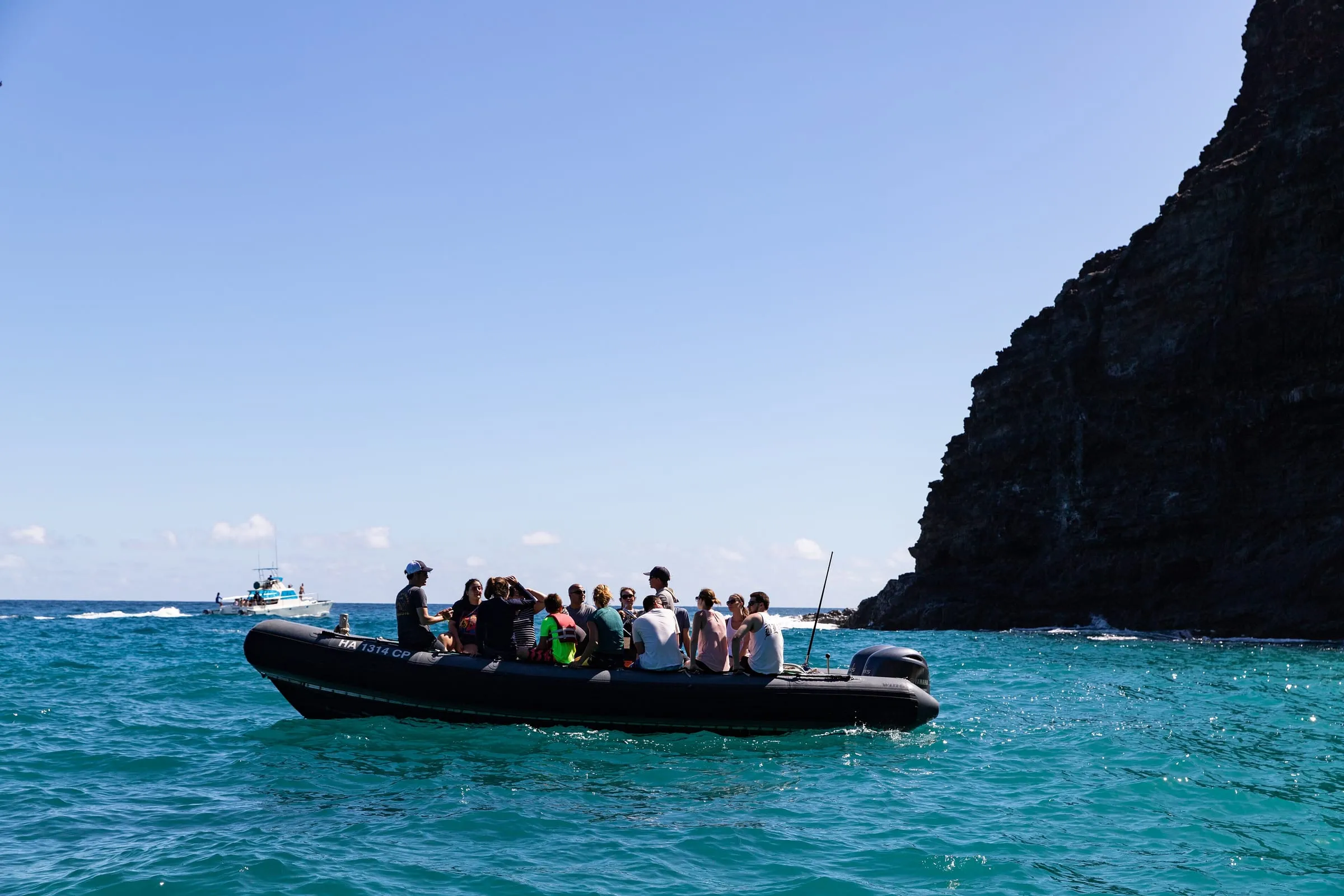
If the trail does not fit your trip, the Nā Pali still can: from the sea on a boat from the west side, which needs no permit at all, or from above in Kōkeʻe State Park, at the Kalalau Lookout at the top of the canyon road, which looks down into the valley the trail ends in. The Awaʻawapuhi and Nuʻalolo trails end on the cliff tops over two more Nā Pali valleys; how far each is open is on what is open on Kauaʻi, and Waimea Canyon and Kōkeʻe has the drive. The Nā Pali by boat, by air or on foot compares them, and Nā Pali Coast boat tours has the boats.
Where these facts come from
- The Division of State Parks (DLNR): its Kalalau Trail page and trail safety page, its Nā Pali Coast State Wilderness Park pages and special permit rules, its Kauaʻi camping page, its Hāʻena and Nā Pali Coast access pages and FAQs, its walk-in announcements of 2025 and 2026, its park notices, its Permits & Fees page, its camping rule and its 2025 parks brochure.
- The Department of Land and Natural Resources: its news release of 13 October 2026 reopening Hāʻena State Park and the day hike.
- Explore Outdoor Hawaiʻi, the state’s camping permit site: the Kalalau calendar, its places and its capacity.
- Go Hāʻena: its overnight camping parking page, its information and FAQ page and its park conditions page.
- The US Naval Observatory: sunrise and sunset at Hāʻena.
Every figure on this page was read against them on 11 November 2026.