Three of Kauaʻi’s best-known waterfalls are a drive, and one is a day’s hike. On the east side, Wailua Falls and ʻŌpaekaʻa Falls are seen from roadside lookouts in Wailua River State Park. On the west side, Waipoʻo Falls drops in two tiers down a wall of Waimea Canyon below the lookouts on the canyon road. On the North Shore, Hanakāpīʻai Falls is the end of an 8-mile day hike from Keʻe on a Hāʻena State Park reservation. Two you cannot reach now: the trail to Uluwehi, the falls most people call Secret Falls, has been closed since Hurricane Lowell, and Manawaiopuna, the falls in Jurassic Park, is on private land and seen only from the air.
Neither east-side falls has a lawful way down to its pool. Below is each falls, how you see it, what it costs and what it takes, as of 11 November 2026. What is open on Kauaʻi has each park’s status, dated.
| Falls | Where | How you see it | What it takes |
|---|---|---|---|
| Wailua Falls | The end of Maʻalo Road, above Līhuʻe | From the roadside lookout | Visitors pay $5 a person and $10 a car, by card |
| ʻŌpaekaʻa Falls | Kuamoʻo Road, above Wailua | From the roadside lookout, across a valley | The same fee as Wailua Falls |
| Waipoʻo Falls | Waimea Canyon | From the lookouts on the canyon road | $5 a person and $10 a car, one payment for Waimea Canyon and Kōkeʻe |
| Hanakāpīʻai Falls | 2 miles up Hanakāpīʻai Valley, from Keʻe | On foot, 8 miles there and back | A Hāʻena State Park reservation |
| Uluwehi (Secret) Falls | Up the Wailua River’s north fork | By kayak and trail | The trail is closed beyond the landing |
| Manawaiopuna Falls | Hanapēpē Valley, on private land | From the air | A helicopter or airplane tour |
| Hanakoa Falls | About 6 miles along the Kalalau Trail | On foot, past Hanakāpīʻai | A Kalalau camping permit, even for the day |
Wailua Falls: the twin falls at the end of Maʻalo Road
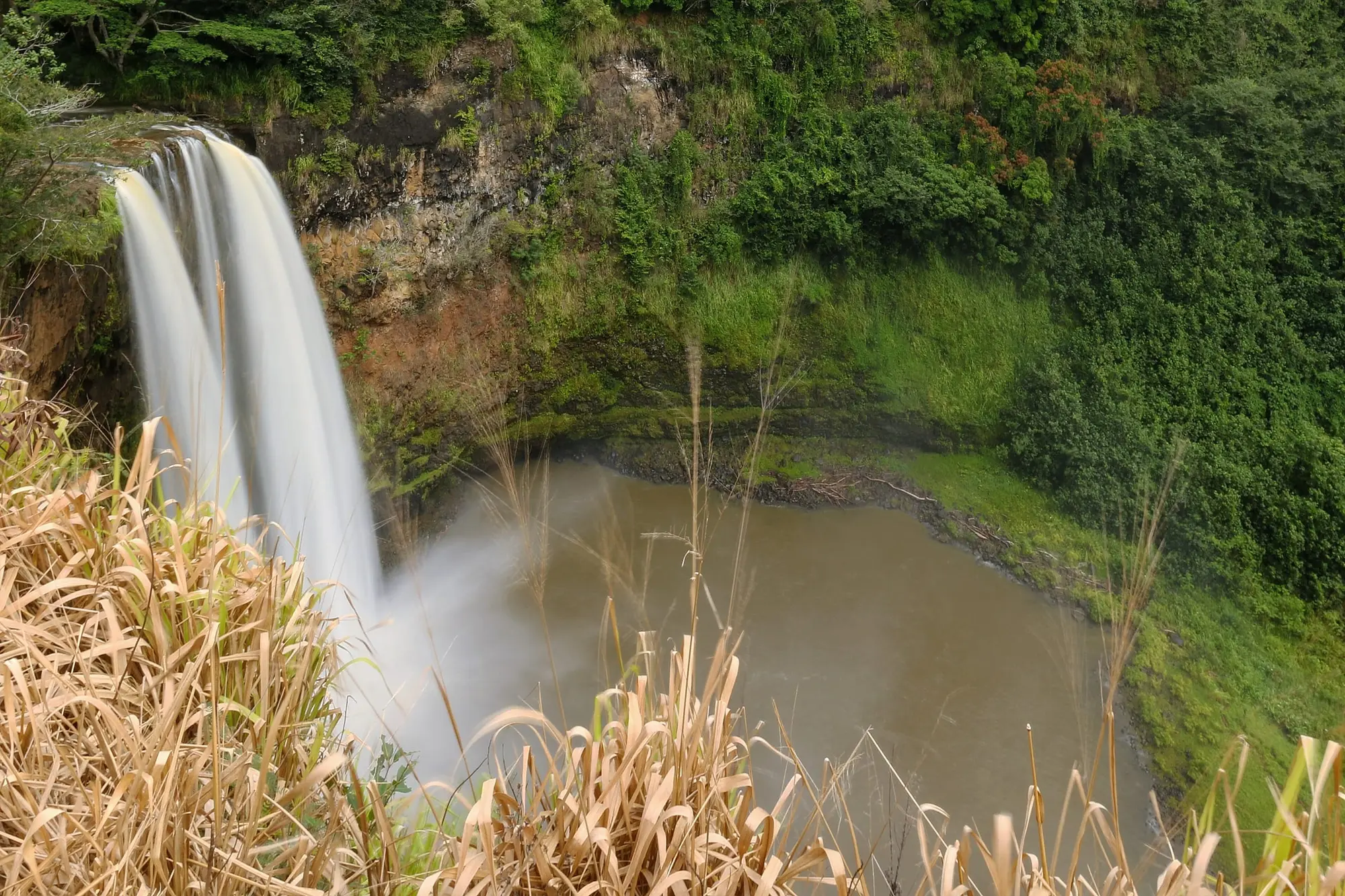
Wailua Falls is at the end of Maʻalo Road (Route 583), which leaves Kūhiō Highway at Kapaia, on the north edge of Līhuʻe, and climbs inland for about 3 miles. The Wailua River pours over a lava cliff there in two streams into a pool below, as in the photograph at the top of this page. The Hawaiʻi Visitors and Convention Bureau gives the drop as 80 feet and notes that some put it nearer 200. It is the falls in the opening credits of Fantasy Island.
You see it from the lookout beside the road, and there is no lawful way down. A steep path runs from the road to the base, and in October 2021 the Department of Land and Natural Resources called it “the illegal hike from the road down to the falls”. That summer the state ticketed hikers there, and by October the county fire department had received five rescue calls at the falls that year.
ʻŌpaekaʻa Falls: from the lookout on Kuamoʻo Road
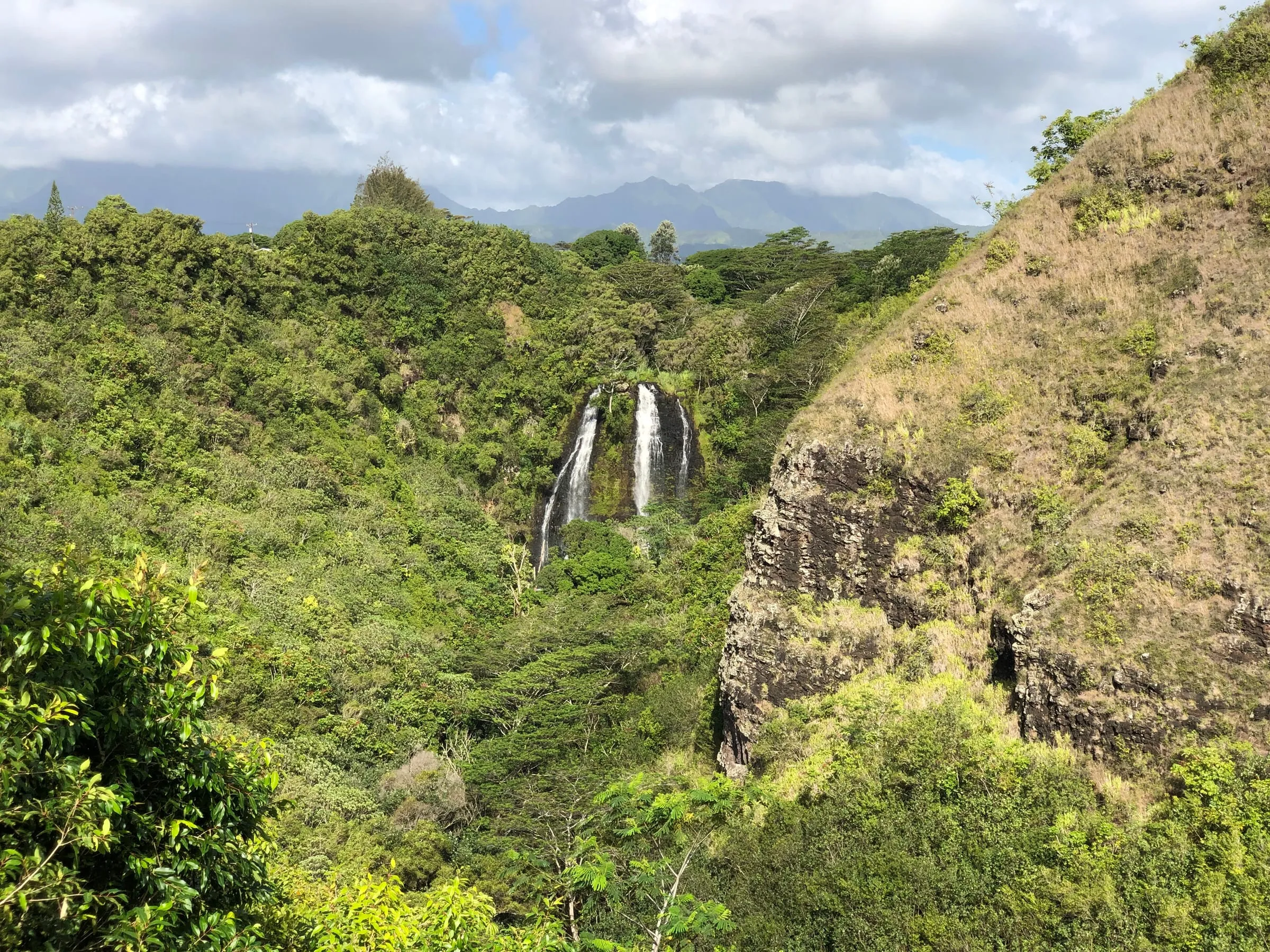
About two miles up Kuamoʻo Road (Route 580) from Kūhiō Highway in Wailua, signs point to the lookout on the right. ʻŌpaekaʻa Falls is 151 feet tall and 40 feet wide by the visitors bureau’s figures, and you see it across a forested valley, as in the photograph below, rather than from beside it. The lookout has picnic tables and restrooms. Poliʻahu Heiau, one of the Wailua River’s ancient places of worship, is part of the same stop, and a short walk uphill and across the road gives a view down the Wailua River valley.
There is no way down here either. A path once ran from near the lookout to the pool, never built by the state, and after two cousins fell to their deaths from it on 19 December 2006, the state blocked it with a steel fence.
What the lookouts cost, and the state’s reopening
Both lookouts are in Wailua River State Park, and since February 2026 the state has charged visitors at each, as at the marina and the Kaumualiʻi area:
- Non-residents: $5 a person, children 3 and under free, and $10 a car.
- Hawaiʻi residents: free, with a Hawaiʻi ID or driver’s license.
- Credit card only. The state’s notice to visitors: “Private party payments are strictly Credit Card Only. Cash transactions are prohibited.”
So two visitors stopping for a few minutes at either lookout pay $20. The park’s hours are 7 a.m. to 7:45 p.m. daily. Kauaʻi state park fees has the fees at every state park on the island.
The lookouts: open with the park, by the state’s release. Lowell closed every park on the island on 7 September 2026. The state’s release of 19 September lists Wailua River State Park among the lands reopening to the public on Monday the 21st, with two limits: no individual kayakers at Fern Grotto, and no hiking past the trailhead at the river’s landing, so Uluwehi stays shut. It sets no limit on the lookouts. The state’s notices page words the same reopening more narrowly, “River and designated landing/trailhead access will reopen”, and names neither lookout either way, and its newest notice, of 12 November, leaves the park out altogether; what is open on Kauaʻi explains why that does not close it again, and carries the park’s status, dated. On the day, a gate or a sign at the lookout is the rule.
Waipoʻo Falls: from the Waimea Canyon road
On the west side, Waipoʻo Falls drops in two tiers down a red wall of Waimea Canyon, and the best views of it are from the lookouts on the road up, not from a trail. Both canyon parks reopened on 7 November 2026, and the Waimea Canyon Lookout, at mile 10.5, two weeks before that, on 24 October. Visitors pay $5 a person and $10 a car, one payment for both Waimea Canyon and Kōkeʻe State Parks.
The Canyon Trail reaches the top of the falls, not a view of them. It starts at the Puʻu Hinahina Lookout, at mile 13.5, or from Halemanu Road, and runs 1.8 miles along the rim, dropping about 1,100 feet, to Kōkeʻe Stream at the lip of Waipoʻo. The Kōkeʻe Museum warns that it is unmaintained and can be very muddy, with loose, pebbly soil above the canyon; that you cannot see the falls from it; that going too near the edge can be fatal; and that beyond the stream, landslides have taken the old trail out. Halemanu Road is one lane and slick when wet, so leave an ordinary car well off the highway near the Kōkeʻe State Park sign and walk in; only a four-wheel drive goes on to the trailhead. The state’s 8 November reopening does not name the Canyon Trail either way, and a sign at the trailhead is the rule. Waimea Canyon and Kōkeʻe has every lookout and trail on the road, mile by mile.
Hanakāpīʻai Falls: the day hike from Keʻe
On the North Shore the falls you walk to is Hanakāpīʻai. It sits 2 miles up Hanakāpīʻai Valley from the beach, which is 2 miles along the Kalalau Trail from Keʻe: 8 miles there and back from the trailhead. Go Hāʻena, which sells the park’s reservations, gives 6 to 8 hours for it; the state says to allow a full day.
The valley trail is the hard part. The state describes it like this:
“An unmaintained 2-mile trail into Hanakapi’ai Valley leads to a waterfall. After crossing the stream about a mile up the valley, the trail becomes more difficult as it meanders over rocks and fallen trees. The upper half of this trail should be hiked only in good weather to avoid dangerous flash floods and falling rocks.”
Go Hāʻena calls it a hike for experienced hikers only, with stream crossings and slow going, and its rule for the streams is the one to keep: do not cross when the water is rushing or murky, and if it rises, shelter in place until it is safe to cross. There is no cell service, and no hiker rescue while the streams are high. On the way, Hanakāpīʻai Beach is for looking at. The state’s trail page says of it, in capitals, “DROWNINGS OCCUR HERE REGULARLY!”, and Go Hāʻena’s rule is to go into the ocean only at Keʻe.
What it takes. A Hāʻena State Park reservation of any kind, a shuttle seat, a parking slot or entry alone, sold by Go Hāʻena 30 days ahead at midnight Hawaiʻi time; Hawaiʻi residents with a Hawaiʻi ID need none. Every reservation covers Keʻe, the trail to Hanakāpīʻai Beach and the falls, and no camping permit is needed, since the falls are up the valley rather than farther along the coast. A hike of 6 to 8 hours is longer than one parking slot, so on a parking reservation the falls take two slots back to back. The shuttle gives a long day without that; on its winter schedule the last pick-up at the park is at 5:40 p.m. In December the sun sets at Hāʻena at about 6 p.m., so start in the morning. Kalalau Trail permits and Hāʻena State Park reservations have the slot times, the prices and how fast they sell. The day hike reopened with the park on 15 October 2026; what is open on Kauaʻi has the trail’s status for your dates.
Uluwehi (Secret) Falls: closed beyond the landing
Uluwehi, which most people know as Secret Falls, is the falls the Wailua River kayak tours are sold on: about two miles up the river’s north fork from the marina to a landing, then a mile or so of muddy trail with stream crossings to the pool. Since Hurricane Lowell the state has kept that trail closed. It reopened the river on 21 September 2026, and its release of 19 September said of the falls:
“Access to Uluwehi Falls (Secret Falls) remains closed in its entirety.”
Its releases of 13 and 23 October set the rule out: kayakers may use the river, the landing and the trailhead, and “Hiking is strictly prohibited past the trailhead until further notice.” So the falls hike is off until the state lifts that rule, although the guided falls tours still on sale describe it. Wailua River kayak tours has what runs on the river while the trail is shut, and the Hulēʻia River trip near Līhuʻe that still ends at a waterfall. What is open on Kauaʻi has the trail’s status, dated.
Manawaiopuna: the Jurassic Park falls, from the air
Manawaiopuna Falls drops about 400 feet in Hanapēpē Valley, on private land, and no road or trail reaches it: you see it from a helicopter or a plane. It is the falls from Jurassic Park, which is why so many people look for “Jurassic Falls”. Most of the helicopter flights from Līhuʻe, and the airplane tour, fly past it on their routes, weather permitting. One helicopter company says it may land at the falls itself, and neither Viator nor FareHarbor sells that flight. Safari Helicopters’ flight titled “JURASSIC CANYON LANDING” lands on the rim of Olokele Canyon instead, as its own listing says. Kauaʻi helicopter tours compares the flights and what each one flies over.
Hanakoa and Kalalau: falls past the permit line
Beyond Hanakāpīʻai the Kalalau Trail takes a camping permit, even for a day hike, and it passes two more falls. At Hanakoa, about 6 miles in, a poorly marked half-mile trail climbs the stream’s east fork, and the state is straight about it: “hazardous, eroded sections but affords a spectacular view of the falls.” At Kalalau Beach, 11 miles in, the trail ends at a small waterfall, and the state warns against lingering beneath it or near the cliff faces, for the constant danger of falling rocks. Kalalau Trail permits has the permit and how fast it sells.
Falls on a tour
- By kayak, outside the state park. Outfitters Kauai’s Hulēʻia River trip paddles upriver from Nāwiliwili and walks three-quarters of a mile through the jungle to waterfalls and swimming holes; Wailua River kayak tours has it.
- With ziplines. Outfitters Kauai’s Kipu Zipline Safari adds a short hike into a valley of small waterfalls, with a swim, to a day of ziplines at Kīpū Ranch; Kauaʻi ziplines has it. Neither it nor the Hulēʻia trip had a date on sale after 30 December when we read their calendars on 10 November 2026.
- From the sea. On the Nā Pali, the rafts from Port Allen go under the waterfalls that drop to the water when the ocean allows; Nā Pali boat tours compares them.
- From the air. Manawaiopuna, the walls of Waiʻaleʻale and the falls of Hanalei Valley are on the helicopter and airplane routes; Kauaʻi helicopter tours has them.
Viator’s full list of Kauaʻi trips is at the foot of this page.
Safe at any falls
- Never swim or stand under a waterfall. Rocks come down with the water. The state’s parks brochure: “Never swim under waterfalls due to potential of rock falls.”
- Watch the stream. The state lists the signs of a flash flood: the water speeding up, a rapid rise, a rumbling upstream and the smell of fresh earth. Move to higher ground at once, and never cross when the water is above your knees.
- Stay at the lookouts. The paths down at Wailua Falls and ʻŌpaekaʻa are off limits: two hikers died on ʻŌpaekaʻa’s in 2006, and the county fire department had five rescue calls at Wailua Falls in 2021 by October.
- Keep fresh water out of cuts, eyes and mouth. The state health department’s advice on leptospirosis: “Do not swim or wade in any freshwater streams or ponds in Hawaii, especially when you have open cuts or sores. Swimming with your head underwater also increases your risk of infection through the eyes, nose, and mouth.” Do not drink stream water without treating it.
- Expect the wet season. Go Hāʻena warns of rougher conditions and more rain from October through April. The falls run fuller then, and the rain that feeds them is what floods the streams. Kauaʻi ocean safety has the winter rule for the beaches on the way, and the best time to visit the rain month by month.
Where these facts come from
- The Division of State Parks (DLNR): the Wailua River State Park page, its park record and its visitor fee notice of February 2026; the Important Park Notices page; the Kalalau Trail page; and its 2025 parks brochure.
- The Department of Land and Natural Resources: its news releases of 7 October 2021 (the illegal hike at Wailua Falls), 19 September 2026 (the Wailua River reopening), 13 and 23 October, and 8 November 2026 (Kōkeʻe and Waimea Canyon).
- Go Hāʻena: its park conditions page.
- OpenStreetMap: where Maʻalo Road leaves Kūhiō Highway.
- The Hawaiʻi Visitors and Convention Bureau: its Wailua Falls and ʻŌpaekaʻa Falls pages.
- The Kōkeʻe Museum: its hiking resources page.
- The state Department of Health: its leptospirosis page.
- The Garden Island, 4 October 2021, for the tickets at Wailua Falls that summer and the fire department’s five rescue calls, and the Honolulu Star-Bulletin, 21 January 2007, for the ʻŌpaekaʻa fence.
- The partner listings: Viator’s helicopter and airplane listings (the flights that pass Manawaiopuna, Blue Hawaiian’s Princeville flight for the falls’ height, and Safari Helicopters’ Olokele landing), and Outfitters Kauai’s Hulēʻia and Kīpū calendars, read 10 November 2026.
- Island Helicopters: its own page, for its falls landing.
- The US Naval Observatory, for sunset at Hāʻena.
Every fact on this page was read against them between 10 and 12 November 2026.