Tunnels is the reef end of Hāʻena’s long beach on the North Shore, about a mile and a half short of the end of the road at Keʻe. Its Hawaiian name is Makua. The sand runs east from Hāʻena Beach Park, the county park under Makana, the peak also known as Bali Hai, and curves out to a point, and offshore a wide reef wraps around a sheltered lagoon. The English name is for the underwater lava tubes that line the reef.
Three things decide a visit. No lifeguard watches it. The lagoon in the middle of the reef is a state refuge that no one may enter without a permit. And the parking is the county beach park’s next door, roughly 40 spaces for a beach that draws hundreds of people a day. Below are the reef and the refuge, when the water is safe, the parking and the shuttle, and the change of hands the beach park is waiting on, as each stood on 11 November 2026. Whether the road is open on your dates is on what is open on Kauaʻi.
The reef
Hāʻena’s best. For the state’s Division of Aquatic Resources, the University of Hawaiʻi’s Fisheries Ecology Research Lab surveyed Hāʻena’s reefs at Makua and Keʻe in 2013 and 2014, and compared their back-reefs, the water between the reef crest and the shore. Makua’s had nearly three times the coral cover of Keʻe’s, 18.9 percent against 6.7, and more species of adult fish, and the researchers wrote that it “had the most healthy and diverse coral community in the area,” sheltered from the waves and washed by a strong flow of water. The lifeguards put it their own way: in the summer months, their notes for Hāʻena say, it “can have the island’s best snorkeling areas.”
A nursery. The back-reef is where young reef fish settle. A 2011 survey of the newly settled fish on Makua’s found them dominated by wrasses and parrotfish: the belted wrasse, the endemic saddle wrasse, hīnālea lauwili, and the redlip parrotfish, palukaluka, with manini, the convict tang’s endemic Hawaiian subspecies, among the rest. That is why the middle of the reef is a refuge, below.
The channel. Makua’s reef is cut by what the researchers call “its large channel and relatively deep water,” which lets the predators in. It is open ocean, and no lifeguard watches it.
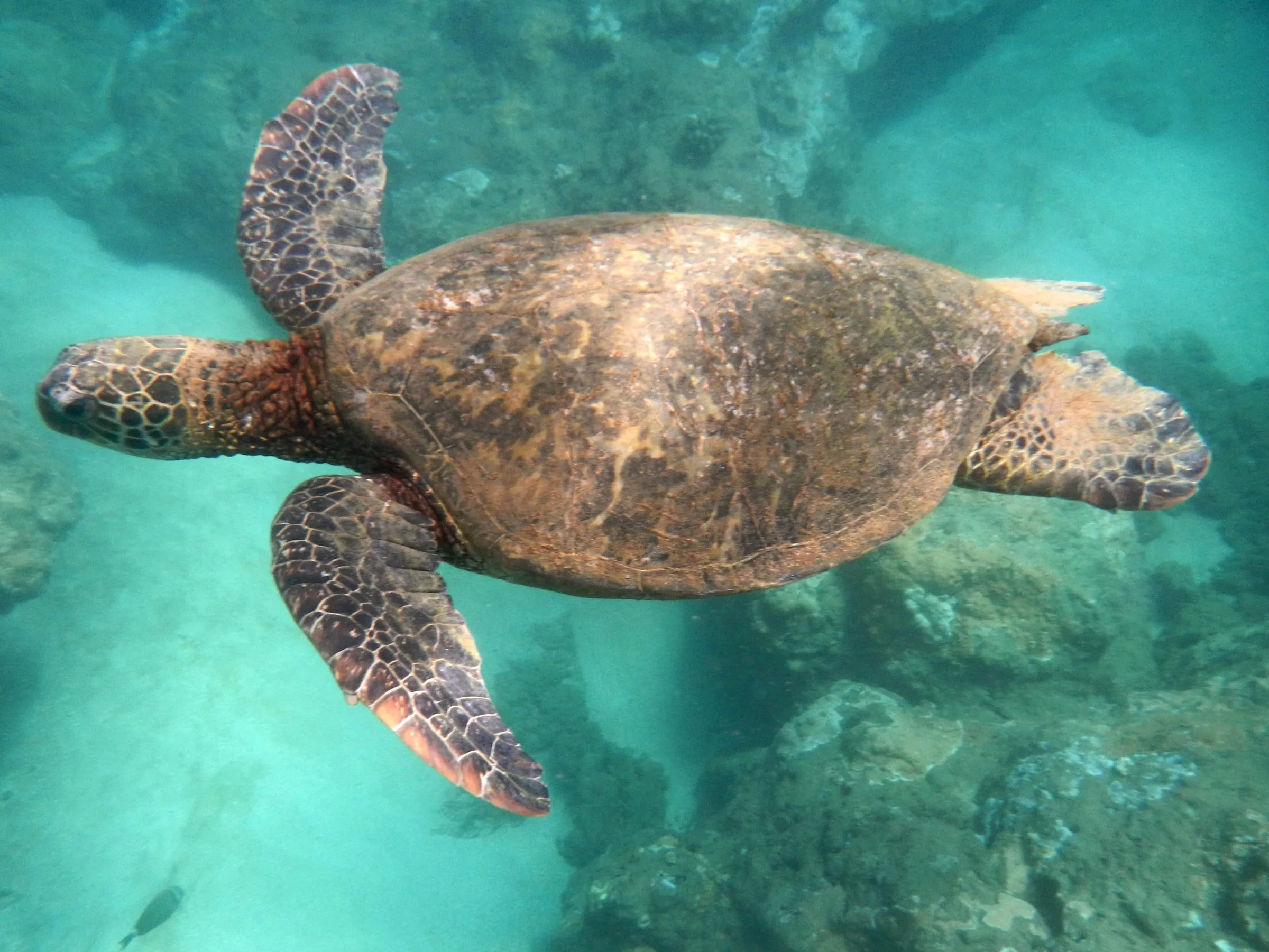
Turtles and seals. Green sea turtles swim these reefs, as in the photograph below, and the state’s plan for Hāʻena’s waters lists endangered hawksbill turtles and Hawaiian monk seals as well. NOAA’s distances: at least 10 feet from a turtle and 50 feet from a monk seal, on land and in the water, and 150 feet from a mother and pup.
The Makua Puʻuhonua: the lagoon no one may enter
The sheltered water in the middle of the reef is closed to everyone. Since 14 August 2015 it has been the Makua Puʻuhonua, a marine refuge inside the Hāʻena Community-Based Subsistence Fishing Area, which covers the water a mile out from Hāʻena’s shore. The Division of Aquatic Resources puts its rule in one line:
“No entry without a special activity permit (applies to vessels and individuals).”
The permit comes from the Board of Land and Natural Resources, for education, research and the like, and the refuge exists, in the rule’s words, for “the preservation and protection of this nursery habitat for juvenile reef fishes.” Swimmers, snorkelers, paddlers and boats are all kept out.
Where it is. The rule draws it as “all State waters and submerged lands located within the fringing reef of Makua lagoon,” a four-sided area fixed by coordinates. On a map, its corners enclose the pale, sheltered water in the middle of the reef’s horseshoe, beginning a few hundred feet off the eastern half of the beach, where the sand curves out toward the point. If you are swimming away from the beach toward the middle of the horseshoe, you are heading into it. The rest of the reef, the shallows along the beach included, is outside it.
What it costs to ignore. A first violation of the Hāʻena rules is an administrative fine of $100 to $1,000, a second within five years $200 to $2,000, and a third $500 to $3,000, with up to $1,000 more for each fish or other creature taken or damaged.
How it came to be closed. The 2008 draft of the recommendations would have kept the puʻuhonua open for swimming and snorkeling. Consultation with the Hāʻena community, the area’s users and the state from 2009 to 2013 made it a smaller area with no entry, and the rule adopted in 2015 allows entry by permit only. The Division of Aquatic Resources drew the boundaries from kamaʻāina knowledge of customary fishing, from the biological and social studies, and from compromises negotiated with the area’s regular users. Kamaʻāina accounts had long named this water a nursery for young fish, and the reef surveys bore them out.
The rest of the reef. Hāʻena’s fishing rules cover every snorkeler outside the refuge too: no feeding fish, no taking live shells, and no taking or damaging sand, coral or rock. Empty shells may be picked up, with no breathing gear but a snorkel, everywhere except inside the refuge.
When to swim, and when not to
Summer, and calm days only. The lifeguards’ notes for Hāʻena, the beach park next door, put it plainly: “The summertime is generally the safest time to swim here. In the winter months, the beach is great for walking the sand but please read signage as it is often too dangerous to swim.” Kauaʻi’s lifeguards count the winter swells from October through April, and so do we: the calm months are May to September.
No lifeguard. No county tower stands at Tunnels. The nearest is at Hāʻena Beach Park, next door to the west, staffed from 8 a.m. to 6 p.m. every day, and it watches its own beach. If someone needs help and nobody is in the tower, the state Health Department’s instruction is to call 911. Snorkelers account for 40 percent of the drownings on Kauaʻi, the Kauai Lifeguard Association says, and Kauaʻi ocean safety has the rules that go with that.
The water in front of the beach park is not the reef. Safe Beach Day, the conditions site the county’s notices point to, describes the bay off Hāʻena Beach Park as bordered by “Makua Reef to the east and Hauwa Reef to the west, but no reef protects the beach itself. It is completely exposed to the open ocean.” In high surf, it warns of a pounding shorebreak, a strong backwash and powerful rip currents, and says the beach park “has been the site of a number of drownings and many near-drownings.” Walking to Tunnels from the lot, you pass that water first.
What the county does on a big day. It names the beaches. On 5 and 6 November 2026 the Ocean Safety Bureau advised no swimming or other water activities at Keʻe and Hāʻena, for high surf and strong currents. On 11 November it advised none along every north- and west-facing shore of Kauaʻi through 12 November, Tunnels included, with the National Weather Service forecasting surf of 18 to 24 feet on north-facing shores at the peak. The Weather Service’s High Surf Advisory for north-facing shores begins at 15 feet and its warning at 25, measured on the face of the wave. The county’s own line: “When in doubt, don’t go out.”
When the highway floods, the tower closes. On 18 June 2026 the county closed the Keʻe and Hāʻena towers for flooding at Mānoa Stream on Kūhiō Highway, and its notice read “Lifeguard services are not available at these locations until further notice.”
Parking, the shuttle and the drive
The lot is the beach park’s. Tunnels has no lot of its own. Hāʻena Beach Park, the county’s 5.5 acres next door to the west, on the same sand, is the way in: two lots, roughly 40 spaces, free, with no reservation. It is not enough. By The Hanalei Initiative’s count, as Honolulu Civil Beat reported in March 2026, the beach park drew 1,400 visitors a day over the Christmas holiday and about 800 a day in summer, when people stay nearly all day. In November 2025 Chipper Wichman of Hui Makaʻāinana o Makana told the paper, “Every morning by 10 a.m. every single parking spot is taken.” Come early, or come on the shuttle.
Never wait or park on the highway. Cars stopped on the highway for a space are what the community is working to end: The Hanalei Initiative posted traffic guards at the beach park for 90 days in summer 2025 to keep the highway clear. The state fines a car parked on the shoulder of the road to Hāʻena State Park $200.
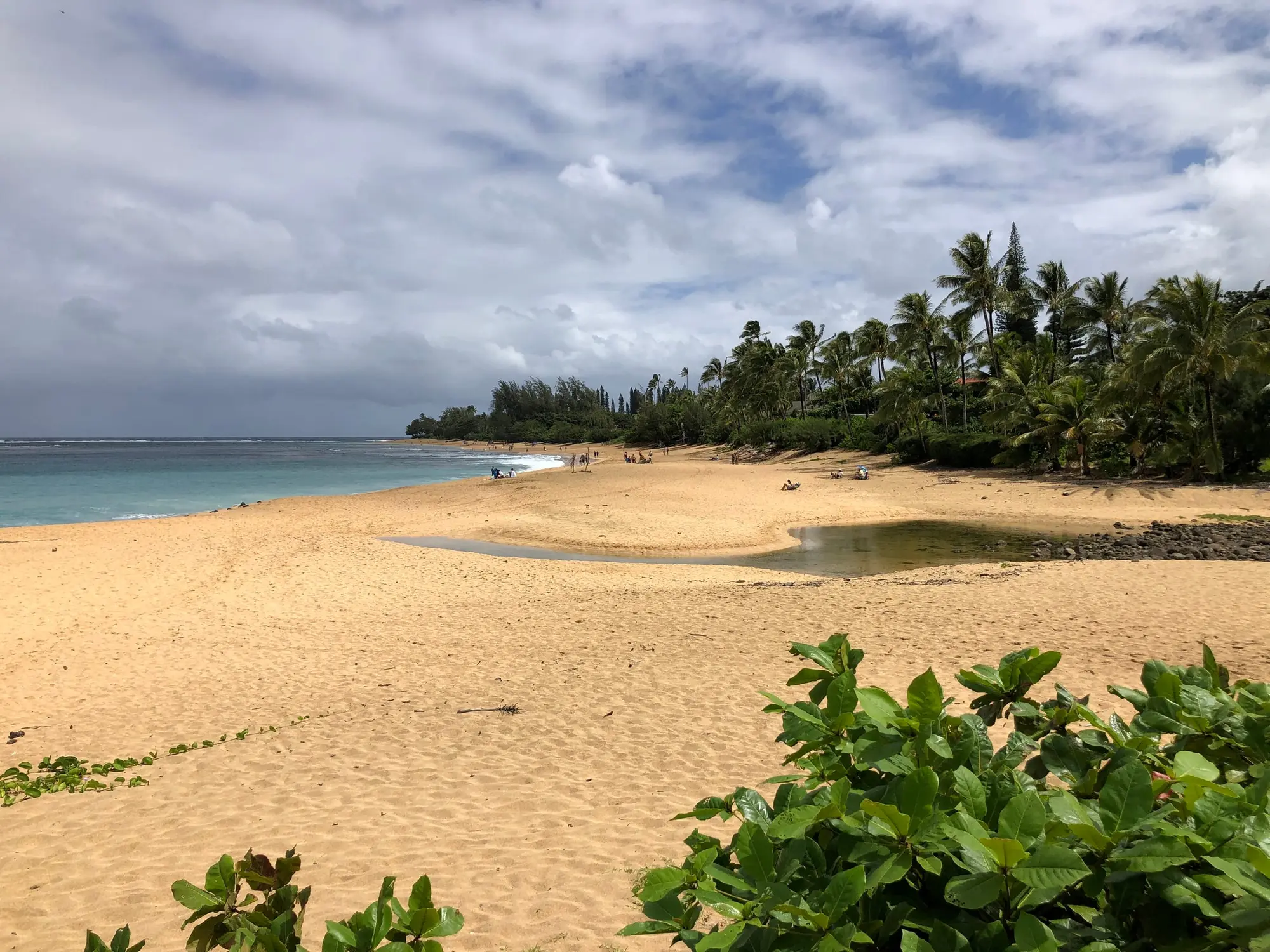
The walk. From the lot the sand runs east past a shallow stream mouth, the one in the photograph at the top of this page, and Tunnels begins about a fifth of a mile along it, some five minutes’ walk.
Headed on to Keʻe? This is not your lot. Go Hāʻena, which sells the state park’s reservations, bars state park visitors from parking outside the park: “Doing so violates our terms of purchase. Parking tickets are $200+ and cars can be towed from nearby destinations.” The rule reaches Hāʻena Beach Park’s lot for anyone headed into the state park: never leave the car here and go on to Keʻe. We go further. On the day of a state park reservation, keep the car out of the beach park altogether, before your slot as well as after it, and come to Tunnels by car on a day with no reservation.
The shuttle stops here. The Kauaʻi North Shore Shuttle from Waipā Park & Ride in Hanalei to Hāʻena State Park stops at Hāʻena Beach Park, and Go Hāʻena sells it as the way to “Makua Beach aka Tunnels” as well as to the state park. Its Princeville departures, at 7 and 9 a.m., run to Hāʻena State Park, and their riders change in Hanalei on the way back. Visitors need a reservation: a round trip at $45 for each rider 16 and over and $25 for ages 4 to 15, with Hāʻena State Park entry included. To get off at the beach park, say so when you check in. The ride back is first come, first served from any stop, and on the winter schedule the last shuttle leaves the state park at 5:40 p.m. It takes small beach and snorkel gear, never a surfboard or a big cooler, and its riders may park only at Waipā, never at a stop along the way. Hāʻena State Park reservations has when each date goes on sale and how fast it goes.
The drive. Hāʻena Beach Park is 36.5 miles from the rental car lots at Līhuʻe Airport, about an hour and 10 minutes on a clear road, and past Princeville the road crosses the one-lane Hanalei Bridge, which closes when the river floods. No bus runs past Hanalei. Getting around Kauaʻi has the drive, and what is open on Kauaʻi the bridge.
What is there, and what is not
Tunnels itself is sand, with trees and homes behind it. The restrooms, showers, picnic tables and pavilion are the beach park’s, and the state’s February 2026 file on the park lists two food vendors working there on monthly county permits. Safe Beach Day’s Hāʻena page lists metered parking; the county’s lots are free. Bring your own snorkel gear, water and shade. There is no camping: the county closed the campground after the 2018 flood and has never reopened it.
Across the highway from the beach park, on the mountain side, is Maniniholo Dry Cave, a wahi pana, a storied place, for the people of Hāʻena. The state’s file on the transfer records rockfall hazards over it, and no injuries or deaths from rockfall there. Burials in the sand dunes along the Hāʻena coast have been documented since at least 1865, the state’s master plan for Hāʻena records: keep off the dunes, and never dig in them.
A county park on its way to the state
Hāʻena Beach Park, and with it the way to Tunnels, is set to become part of Hāʻena State Park. The state’s own case for it is that when Hāʻena State Park went to reservations, “the crowds have migrated down the road.” The County Council voted unanimously on 26 November 2025 to give the beach park and the Maniniholo Dry Cave to the state, and on 27 February 2026 the Board of Land and Natural Resources voted unanimously to approve the acquisition in principle, pending the two governments’ due diligence. It put off the other three items: the executive order that would hand the park to the Division of State Parks, the extension of Hāʻena State Park’s boundary to take it in, and the declaration that the transfer needs no environmental assessment. The board must vote again, and no agenda since, through the one for its meeting of 13 November 2026, has brought the park back. In March the acting state parks administrator said the beach park stays the county’s until the transfer is complete.
What it would change is not settled. Once the park joins Hāʻena State Park, the Division of State Parks is to fund a community plan, and the questions it is to answer, Civil Beat reported, include how many people the park can sustain, the balance between visitors and residents, and whether visitors will be charged to park. The county is to keep providing lifeguards for a year after the transfer. Until then the beach park is free and needs no reservation.
With Keʻe in the same day
Keʻe’s lagoon is 1.2 miles on by road from the beach park, at the end of the road inside Hāʻena State Park, and the two make a North Shore day only with a plan. The shuttle is the way to do both on one ticket. Tell the attendant at check-in that you will get off at the beach park and board again for the state park, and expect to wait at the beach park for a shuttle with room: only your reserved departure has a guaranteed seat. By car, keep them to separate days. Go Hāʻena’s terms bar state park visitors from parking outside the park, so the car cannot wait at the beach park while you are at Keʻe, and our advice goes further: on the day of a state park reservation, leave it out of the beach park before your slot as well as after it. Tunnels by car is a day with no state park reservation. On a winter day the county’s advisories have named both beaches at once, as on 5 and 6 November 2026. Keʻe Beach has the lagoon at the end of the road.
Past Tunnels
From October to April the calm-water snorkeling moves to the south shore, which faces away from the winter swells: Poʻipū Beach has two lifeguard towers, and Kauaʻi snorkel tours has the guided snorkels there and by boat. On the North Shore, Hanalei Bay is the swim in town, and the Nā Pali cliffs past Keʻe are for the boats. Viator’s full list of Kauaʻi trips is at the foot of this page.
Where these facts come from
- The Division of Aquatic Resources: the Hāʻena fishing area’s rules (Hawaii Administrative Rules chapter 13–60.8), its page for the area, and its 2016 management plan with the University of Hawaiʻi’s reef surveys of 2011, 2013 and 2014.
- The Division of State Parks and the Board of Land and Natural Resources: the Hāʻena FAQ, the February 2026 submittal on the beach park’s transfer, the board’s minutes of 27 February 2026 and its agendas since, and the Hāʻena State Park master plan.
- The County of Kauaʻi: its parks facility list and its Ocean Safety Bureau’s notices of 18 June, 5 and 6 November and 11 November 2026.
- The Kauai Lifeguard Association, the state Health Department’s list of lifeguarded beaches, Safe Beach Day and the National Weather Service in Honolulu.
- Go Hāʻena: its information and FAQ page and its shuttle page.
- Honolulu Civil Beat, 5 November 2025 and 4 March 2026, for the parking, the crowds and the transfer.
- NOAA Fisheries, for the wildlife distances, and OpenStreetMap, for the beach, the lot and the drive.
Every figure on this page was read against them on 11 November 2026.